Showing posts with label Italy. Show all posts

Thursday, January 17, 2013

Does besto pesto come from a Costco Wholesale warehouse?

Costco Wholesale says the basil in its Kirkland Signature Basil Pesto comes from Italy.


By VICTOR E. SASSON
EDITOR

The blend of basil, cheese, olive oil, garlic and pine nuts called pesto adds a summer accent to dishes all year around.

After my first taste of pesto 40 years ago in Europe, I found a great blender recipe and enjoyed the basil-based sauce with pasta, fish and egg dishes.

The Kirkland Signature Basil Pesto "uses only Genovese Basil grown in the Liguria region of Italy, which is a narrow strip of mountainous land bordering the Mediterranean Sea and surrounding the city of Genoa [where pesto originated],"  according to the label.

A 22-ounce bottle, enough for 2 pounds of pasta, was $7.99.


A teaspoon of Costco pesto on an egg-white omelet.


The blender recipe from chef Marcella Hazan calls for 2 cups of fresh basil leaves -- packed -- and the result is a great-tasting pesto.

The Kirkland Signature pesto is fragrant and tastes good, but the first ingredient listed is a "basil blend" of leaves, oil and cheese.

I haven't tried Costco's pesto with the imported artisan egg tagliatelle noodles I found at my Hackensack warehouse store last week, but as of now, I give the edge to Hazan.

Of course, Costco's pesto will have to do until basil appears in the market or starts growing in my garden again.

Here is Hazan's recipe for making pesto in a blender, minus salt and butter.


She used two kinds of cheese, but I use only grated Pecorino Romano, a sheep's milk cheese.


I use the "Chop" setting on my blender -- a slow speed that allows me to push down the basil, garlic and other ingredients as the blender worked.

BLENDER PESTO


Enough for 1 pound or 6 servings of pasta

2 cups fresh basil leaves, packed

1/2 cup extra-virgin olive oil

2 tablespoons pine nuts

2 cloves garlic, lightly crushed with a heavy knife blade and peeled


1/2 cup plus 2 tablespoons of freshly grated Pecorino Romano cheese


1. Put the pine nuts, garlic cloves, basil and extra-virgin olive oil in the blender and mix at slow speed.  Stop from time to time and scrape the ingredients down toward the bottom of the blender cup with a rubber spatula.  


2.  When the ingredients are evenly blended, pour into a bowl and beat in the two grated cheeses by hand. (This is not much work, and it results in more interesting texture and better flavor than you get when you mix in the cheese in the blender.)  If you do not want to use the pesto immediately, put it into a closed container and freeze it before you add the cheese.


3. Before spooning the pesto over the pasta, add to it a tablespoon or so of the hot water in which the pasta has boiled.  Do not heat the pesto before you add it to the pasta.


Note: The best pesto has a great deal of basil in it. I use leaves and stems, and pack a measuring cup with it. The more basil, the better. I've also added mint, rosemary, arugula, parsley and other herbs, but think basil makes the best pesto.


Wednesday, December 26, 2012

A Feast of the Seven Fishes -- just barely

Black Tiger shrimp, above, and a frittata with salted cod fish, below, were two of the courses in a hastily improvised Feast of the Seven Fishes on Christmas Day.


With the meat eaters in the family preparing a Christmas dinner of Cuban roast pork and lamb, I tried to reproduce a Feast of the Seven Fishes with what I had on hand.

A few days earlier, my wife made a canned fish salad with yellowfin tuna, pink salmon and sardines, so I decided to start my seafood meal with that, knocking off three of the seven fish.


My first course: Canned fish salad with Dijon mustard, lime juice and ground cumin.


We had plenty of salted cod fish for a fluffy frittata with whole organic eggs, low-fat milk and shredded Italian cheese, topped with fresh and sun-dried tomatoes, and pesto, and finished under the broiler.

In the freezer, I also had a box of New Zealand Green Lip mussels, which I popped into the oven for about 15 minutes (under the broiler).


Mussels with brown rice, black beans and organic diced tomatoes, and vegetables.


A slice of the cod-fish frittata was my second course, followed by a big plate of mussels, vegetables and organic brown rice with black beans and organic diced tomatoes prepared in an electric cooker.


Rice, beans and diced tomatoes went into an electric cooker at the same time.


I should have stopped there, but to get to seven fishes, I had to have a few jumbo shrimp and a piece of salted mackerel fillet with plum concentrate I found at H Mart, a Korean supermarket, and put in the freezer.

The Feast of the Seven Fishes, which originates in Italy, is usually eaten on Christmas Eve.

I threw together my seafood mini-feast after our plans for a multi-course Christmas dinner for 8 at Lotus Cafe in Hackensack fell through when our guests cancelled.

When I mentioned that plan to another friend, he said it reminded him of "A Christmas Story," a movie about a family that had their Christmas dinner in a Chinese restaurant.

I had never seen the film, so I recorded and watched it, discovering a couple of disturbing scenes (see photos below). 


"A Christmas Story" is a 1983 film based on a Jean Shepherd screenplay. In this scene at a Chinese restaurant, the waiters' inability to pronounce the letter "r" is mocked.

Here, the restaurant owner has just hacked off the neck and head of the duck the family would be having for Christmas dinner after their turkey was eaten by stray dogs.

Thursday, October 21, 2010

The best credit card to take overseas

On a farm in Italy, I was served lake fish, roasted potatoes and sauteed greens.
If you travel overseas, most credit cards will charge you an extra 2% or 3% as a foreign-currency conversion fee. That may not sound like much, unless you spend $2,500 on restaurants, hotels, transportation and gifts, as I did in Italy last month.

The one card that doesn't charge such a fee is Capitol One's Visa, which I carried along with an American Express card that charges a conversion fee. The Capitol One card also rebates 1% of everything you charge on it. 

And when both cards were stolen by a pickpocket in the Milan subway, I found Capitol One's customer service far superior to that of American Express. 

The former sent a new credit card to my hotel by overnight mail, while the latter made me make two long visits to an American Express travel office. When I finally got the new card, I couldn't buy American Express traveler's checks with it or get a cash advance.

Interest rates don't concern me, because I always pay off my balance in full each month and collect hundreds of dollars in rebates every year. I received my Capitol One statement recently and got a better idea of how much I spent in Italy for specific meals and other expenses.

The weak dollar was a thorn in my side during my trip to Milan, Venice and Gallarate. When I left the U.S., a dollar was worth only 78 cents in euros. Then, the dollar fell further, to only 70 cents in euros.

The Capitol One card used a conversion rate ranging from 76.2 to 77.7.

All the meals I ate in Italy seemed expensive, though tax, tip, wine, mineral water and bread were included. Portion size varied, so I sometimes over-ate and over-spent. My priciest meal was at Noblesse Oblige, a seafood restaurant in Milan, where two courses were 35.5 euros or $45.65

I spent about  $91 on diesel fuel for the Alfa Romeo 159 sedan I drove from Milan to Venice and back, and that didn't even fill the tank completely. I spent about $50 on highway tolls, too, but public transportation was relatively inexpensive.

So the best strategy is to avoid staying in the big cities, and use the train or ferry for day trips. 

My hotel room in Milan was half the size and twice the price of the one I had in Gallarate, where the food was just as good but cheaper. 

In Venice, I stayed in a new hotel on Lido island for about $125 a night, with a full breakfast and a panoramic view of the enchanted city, and took the small passenger ferries three or four times a day to reach the Jewish Quarter and other attractions. 

From Gallarate, it was easy to make a day trip to Lake Maggiore, where I had a bountiful lunch on a farm.


Posted by Picasa

Sunday, October 3, 2010

Shopping, cooking and dining notes

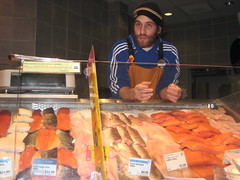
Staff at Willowbrook Whole Foods Fish CounterImage by skeggy via Flickr
Fish counter at a Whole Foods Market (not Paramus).


It's been fairly easy to keep eating at the level I did in Italy. There is plenty of fresh seafood available in North Jersey -- at Costco, Whole Foods Market and Fairway Market -- organic salad mix and decent produce.


Last week, I picked up two pounds of what was labeled Pacific true cod at Costco in Hackensack for $5.99 a pound. I cut the fillet into pieces, coated them in bread crumbs and chili spices and baked them at 375 degrees for about 25 minutes, until they gave up their liquid and started to flake.


Two days later, I bought two dozen farmed prawns from Vietnam at Costco for $9.99 a pound (vein removed). I shelled them, marinated them in the juice of three lemons and seasoned them with red-pepper flakes, garlic powder, black pepper and a little salt. Meanwhile, I cut up sweet peppers and garlic, opened a can of diced tomatoes and boiled a half pound of organic pasta bowties from Whole Foods in Paramus.

I sauteed the peppers and garlic in olive oil, added the diced tomatoes and then the shrimp with all its marinade. When they were cooked, the pasta went in. I mixed it well and put the pot on the table with a slotted spoon. Next time, I'll drain the diced tomatoes. 

When Italians eat pasta, the sauce coats the spaghetti, tagliatelle or whatever they use, and doesn't pool in the bottom of the plate. Of course, there is always just a little sauce left over to be wiped up with bread.

Some of the large sizes at Costco make me wonder if the store expects customers to do clam bakes at this time of the year. Little Neck clams and mussels were in the fish case, but only in 5-pound packages.

Having recently returned from Italy, I couldn't pass up a wedge of Kirkland's imported Grana Padano at $8.99 a pound, a grainy, skim-milk cheese from cows that are grazing on the same grass their predecessors did in Roman times, according to the package. 

There is a great fish counter at Whole Foods in Paramus, with fresh seafood arriving seven days a week. I usually buy what's on sale, such as large, whole whiting for $4.99 a pound. My wife cut these in half to fit in the pan, coated them in flour and fried them.


My wife found farmed whole branzino for $5.99 a pound (usually $9.99 a pound). Two branzini that  weighed just under two pounds made a great dinner for three, seasoned, stuffed with herbs and lemon slices and baked in the oven.


I also love the fish counter at Fairway Market in Paramus, but I'm often put off by high prices, as I was on a visit to the store Saturday morning. I did buy four, one-pound packages of salted cod fish ($8.99) and one of salted pollack ($5.99) to compare with the cod.

I needed tomatoes, but one-pound packages of small, round Campari tomatoes were $2.99 -- too high even if they're herbicide free. Sometimes, Fairway sells three packages for $5. Why not on my visit? 

I wanted to try Polar lemon-flavored seltzer at 12 cans for $1.99, but inadvertently purchased Polar Dry Orange, which contains 6% orange juice, according to big lettering on the package. To my horror, I read the small lettering of the ingredient list when I got home, only to discover it also contains high fructose corn syrup, the first time I've seen a seltzer with it.


I picked up Marco Polo red-pepper spread (spicy) from Turkey for $2.99, compared with a similar product from Macedonia on the shelf above for $4.99.

 Australian beef

The ShopRite sales circular that came with the paper is offering Nature's Reserve, grass-fed, free-range beef from Australia for $3.99 a pound with a store card, through Saturday, Oct. 9. You have to buy several pounds of it -- the whole beef tenderloin for filet mignon -- and trim it before cutting it into small steaks or thin slices for Korean barbecue.

Here is a link to the U.S. federal trademark registration of Nature's Reserve beef in 2003. The producers say the cattle are never confined and no additives are used: Nature's Reserve Australian Beef

Last month, the Coles supermarket chain in Australia announced it would not sell beef containing hormone growth promotants. That has upset beef industry groups, including the Australian Beef Association and the Cattle Council of Australia, because smaller cattle will sell for less. 

At lunch one day in Italy, I met two Australian women who were traveling without their husbands and children. I asked them about Australian beef. They were not familiar with the Nature's Reserve brand, which apparently is sold only in the United States.

But one said beef producers are now confining cattle in feed lots and feeding them grain for the kosher and halal markets in the U.S.

Chef Ji's Moon Jar in Fort Lee


Chef Ji Cha, who competed on Gordon Ramsay's "Hell's Kitchen" TV reality show a few years ago, has revised the menu of her Korean fusion restaurant and is preparing to open for lunch starting Oct. 15. I had dinner there Saturday night, and will report on the meal in my next post.

Monday, September 27, 2010

We have Lodi, they have Lodi


We have E-ZPass, and the Italians have Telepass, plus unmanned booths where you can pay your highway toll with a credit card.

We have Lodi, N.J., and they have Lodi, Italy, north of Milan. They have really low rail fares, but pricey tolls on the autostrada, and filling the tank of the Alfa Romeo 159 turbo-diesel sedan I drove would cost more than $100.  

But they have full- and self-service, and if you pump your own fuel, you save money on each liter. And their tractor-trailer drivers are sweethearts, compared with ours.

Exxon is still called Esso there, and many Esso stations have On The Run convenience stores, as we do here. Each service area along a highway seems to have a service station run by a different oil company, as opposed to the uniformity on our toll roads.


I paid 1.24.9 euros to 1.30.9 euros per liter for diesel or 4.75 euros to  4.97 euros per gallon (3.8 liters equal 1 gallon). That's $6.08 to  $6.37 per gallon (at $1 equals 78 euro cents).

Yet, Italy seems to have an inordinate number of gas- and diesel-guzzling Porsche, BMW, Mercedes and Land Rover SUVs being driven at insane highway speeds and tailgating slower drivers, despite a speed limit of 130 kilometers an hour (78 mph).


We have mostly junk food at service areas and they have good and bad food at service areas, but their highway Autogrill restaurants charge high prices, especially for such regional products as ham, cheese, rice, chocolate and wine sold in adjacent stores. 

If you stop for an espresso (1 euro), you have to walk through the entire store to reach an exit. Usually, you pay the cashier first, then give the receipt to the espresso-machine jockey to get your coffee.


On Sept. 13, I stopped at an Autogrill on the A-1 autostrada to eat three cheese sandwiches I made from my hotel's free breakfast buffet, and stared incredulously at lighted signs above the grill that offered a meal consisting of two slices of pizza, french fries and a large soft drink for about $15.

A couple at the next table ordered a big lunch, including a small cup of fruit for $5.50, a Sorrento salad for $7 and a chicken entree for $15.25 (at $1 equals 78 euro cents). They left their receipt behind. 

The prices in the duty-free food store at Milan's Malpensa airport are even higher -- more than $10 for a pound of Ferrarini dried pasta from Bologna.

I bought an Italian leather bag for my wife at the airport, and got an immediate credit on my charge card for the tax I paid. Now that I am home, I wonder whether I could have gotten credit for all the tax I paid on restaurant meals.

Enhanced by Zemanta

Tuesday, September 7, 2010

I'm off to eat Italy

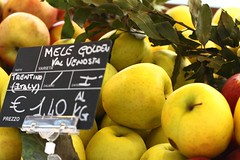
Mele Golden - Eataly #4Image by Montanaro Maurizio™ via Flickr


Chef Mario Batali and his partners have opened another Manhattan emporium of Italian food they call Eataly, but I'm going them one better with a trip to Milan and Venice.

I know the food will be fabulous in the north of Italy, but I've already had a great summer filled with delicious, wild-caught seafood and farm-fresh fruits and vegetables right here in North Jersey.

I plan to take notes and regale you with descriptions of my meals, and I'll try to drop into food stores to see what Italians are buying to prepare at home. I'll be back in under two weeks. 

Italy is where the Slow Food movement began, and the first Eataly opened there as a showcase for the many antidotes to fast food -- a combination market and cafes.
Enhanced by Zemanta

Saturday, March 27, 2010

Why are these tortillas green?

La Flor de PueblaImage by Hagens_world via Flickr


I had lunch with a friend yesterday at La Batalla, a small, colorful Mexican restaurant with groceries in Bergenfield. Non-meat offerings were limited, but I enjoyed two soft tacos with small shrimp, served with refried beans and yellow rice.

After we paid, I noticed stacks of tortillas, including green ones I had never seen before (Mi Pueblito brand from Passaic city, where thousands of Mexicans live). A customer and the woman who worked there didn't know why they were green. My friend looked at the label and said "green corn." Was that a statement or a question, because when I got home I saw only "corn flour" listed. (Photo: Produce store in Mexico.)

I wanted to use the tortillas for dinner last night, so I heated three of them on my stove-top griddle, topped them with sliced provolone cheese and stacked them on a plate. I made three sunny-side-up eggs in extra-virgin olive oil with salt and coarse Aleppo red pepper and put them over the tortillas and melted cheese, which were delicious soaked in the broken yolks.


I had mixed vegetables on the side and drank pinot grigio from Italy.


La Batalla, 83 N. Washington Ave., Bergenfield; 
201-385-0303. Credit cards accepted. Web site:
La Batalla


Reblog this post [with Zemanta]

Thursday, March 18, 2010

Trader Joe's is still on my list

Niman Ranch, Inc.Image via Wikipedia


Before we pledged to eat meatless meals more than two weeks ago, Trader Joe's was a reliable source for uncured, preservative-free bacon, hot dogs and cold cuts, and incredible, naturally raised, fully cooked St. Louis-style ribs from the Niman Ranch -- all at good prices.


When I found myself in Westwood yesterday, I dropped into the Trader Joe's there to see what else might help us diversify our homemade dinners.

I went looking right away for one of our favorites -- sliced yogurt cheese with jalapeno ($4.69) -- and discovered shredded soy three-cheese blend ($3.79), and other soy cheeses for future shopping trips. I also picked up some great hand-made tortillas -- flour and whole wheat ($2.49 each) and habanero lime ($2.69).

And I bought another bottle of raw organic agave sweetener ($2.99) , which is terrific over yogurt or pancakes, and Trader Joe's premium extra-virgin olive oil ($7.99 for 32 ounces). The front label says imported from Italy, but on the side, it lists four countries for the product: Italy, Spain, Argentina and Greece.

Web site: Trader Joe's


Reblog this post [with Zemanta]

Monday, January 4, 2010

A cross-cultural breakfast

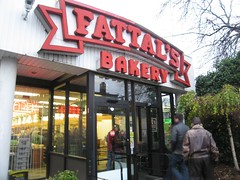
Fattal's Bakery (& Grocery (& Jewelry))Image by wka via Flickr

When it came time for breakfast today, I found I was out of my usual fish -- canned red salmon and smoked wild salmon, and though I had sardines, I ate those most of last week.

So I immediately thought eggs and assembled a quick meal from a number of sources:

First, I made a plain egg-white omelet in organic, Italian extra-virgin olive oil (eggs and oil from Costco, Hackensack) and seasoned it with salt and coarse red Aleppo pepper (Fattal's Bakery in Paterson). I heated up leftovers -- scrambled eggs with strips cut from whole-grain tortillas (Trader Joe's, Paramus) and tomatoes, and plated the omelet next to it, dousing both with Valentina's Mexican hot sauce (Hackensack Market, Hackensack).

I warmed four pocket bread halves (Fattal's) in the toaster, took prepared Libano Verde-brand hummus wuth tehina from Lebanon (also Fattal's) from the fridge, put some Arirang-brand cabbage kimchi in a bowl (Gaboh Inc., Englewood) and dug in. I drank Bromley black tea (ShopRite).
Reblog this post [with Zemanta]