Showing posts with label Australian beef and lamb. Show all posts

Sunday, December 4, 2011

O say can you taste the grass?

In the pastures
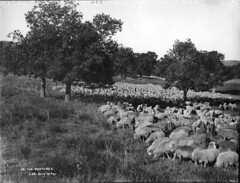
Image by Powerhouse Museum Collection via Flickr
Raising sheep on grass is common in Australia.


Editor's note: Today, I discuss grass-fed beef, lamb, milk, cheese and eggs, all of which are available in North Jersey.


The phrase "all natural" is thrown around with abandon, but there are no government or food industry standards to enforce it.


The best you can do is to look for meat and dairy products from animals that are treated humanely and raised on their natural diets -- free of antibiotics, growth hormones and animal byproducts.


Chief among them are pasture-raised Australian beef and lamb sold at ShopRite supermarkets, Costco Wholesale and other stores.


Unfortunately, labels carry little information on how cattle and sheep are raised in Australia, but ShopRite sales fliers call the beef -- sold under the Nature's Reserve brand -- "All Natural, Free Range, Grass Fed."


I was told by Meat and Livestock Australia Ltd. (MLA) that Nature's Reserve beef comes exclusively from cattle that are fed grass from start to finish. They are never confined to a feed lot, but they do receive some growth hormones.


The racks and boneless legs of lamb sold under the Costco label, Kirkland Signature, or sold without that label, such as the lamb osso bucco I saw last week in the Hackensack warehouse store, are from sheep raised in the same way-- except they do not receive any growth hormones.


Originally, MLA told me no growth hormones were used in beef sold under the Nature's Reserve label, but later corrected that.


Cattle and sheep stomachs are designed to turn grass into protein. When cattle are fed grain -- as the vast majority in the United States are to speed growth -- they can become sick. 


And the wide use of animal antibiotics is making humans resistant to prescribed antibiotics.


Nature's Reserve steaks, roasts and whole beef tenderloin for filet mignon are sold at ShopRite for about $6.99 a pound and even less when they are on sale. 


The meat is lean and contains beneficial Omega 3 fatty acids. It cooks quicker than conventional beef and is best when prepared medium rare.


I once saw grass-fed steaks from New Jersey on sale at Whole Foods Market in Paramus for $9.98 a pound, and the Fairway Market across town sold grass-fed, rib-eye steaks for $14.99 a pound and grass-fed burgers for $5.99 a pound in June 2010.


On Saturday, Costco's prices for Australian grass-fed lamb were $5.99 a pound for the boneless leg, $7.99 a pound for loin chops and $13.99 a pound for racks.  


Before I stopped eating meat nearly two years ago, the small lamb chops in the rack were my favorite. I would trim the rack and cut it apart, broiling the chops only until they were rare. They would literally melt in my mouth.


Of course, you don't taste the grass. But the meat is so pure and flavorful, compared to conventionally raised lamb, it needs little more than a bit of salt.


The current price of $13.99 a pound for a rack of lamb chops at Costco compares to the price I recall from a couple of years ago, $9.99 a pound.


The Australian whole beef tenderloin was ideal for slicing thin, marinating with Korean barbecue sauce and cooking quickly on a stove-top grill before wrapping the beef in red-leaf lettuce with rice, kimchi and garlic at the table.


Grass-fed beef and lamb are among several products from pasture-raised animals available in North Jersey.


Fairway Market sells milk from grass-fed cows. Trader Joe's has sharp cheddar cheese made with milk from pasture-raised cows in New Zealand ($5.49 a pound).


On Friday, for $5, I picked up two dozen Grade A Large Brown Eggs "from grass-fed hens with freedom in the field" at H Mart, the Korean supermarket in Englewood. The yolks are a healthy shade of yellow.


They are distributed by Swiss Villa LLC in Lykens, Pa., with a label that tells you the package is made from recycled PET, fewer than 350 hens forage on a pesticide-free acre of pasture "spring to fall," and the eggs come from "Swiss-peasant-descendant, small-scale farmers."


"You would enjoy seeing the hens scatter out over the pasture meadow each morning as dew droplets mirror the rising sun," the label says. 


I'm sure I would, as long as I was served a breakfast of their eggs right away.


Here are Web sites to help you find grass-fed meat.


Australian Lamb


The site lists Costco Wholesale and Stop and Shop supermarkets as sources of Australian lamb. Some brands to look for are Country Meadow Austral American Lamb and Opal Valley.


Australian Beef


ShopRite and Pathmark supermarkets in North Jersey are listed as sources.


Meat and Livestock Australia Ltd.


Meat and Livestock Australia is a marketing, research and development  agency that represents ranchers, processors, exporters and others involved in meat production in Australia.


To take a virtual farm visit in Australia, click on this link: 


On a Farm Down Under


Enhanced by Zemanta

Friday, May 21, 2010

ShopRite answers competitors

The ShopRiteImage by joshuapaquin via Flickr


The ShopRite sales flier delivered with my newspaper this morning answers the beef sales of three competitors, noted in my previous post, How low can they go on beef prices?

USDA choice, top round London broil is on sale for $1.49 a pound and Certified Angus Beef London broil is going for $1.99 a pound, both with a Price Plus card. This is conventionally raised beef, so you'll also be eating antibiotics, growth hormones and, probably, animal byproducts (bits of dead animals, kitchen scraps and so forth in cattle feed).

We're not eating beef right now, but if we were, I'd go to ShopRite and check out its price for Australian free-range, grass-fed filet mignon, which is raised without any of the nasty stuff and sold here at lower prices than U.S. beef.


Reblog this post [with Zemanta]

Friday, May 14, 2010

More hype from New York-based Fairway Market

Picture of Fairway Market - Paramus Location, ...
Fairway Market on opening day in Paramus.(Wikipedia)


If you're not reading the Fairway Market sales flier, you are missing out on one of the slickest marketing campaigns for a supermarket in North Jersey.


Farm-raised shrimp, conventionally raised prime beef -- all of it looks terrific, and there are photos of the humans behind each department at its Paramus store with a quote or two for good measure. 

None of this can obscure the truth -- that Fairway is selling a lot of pretty ordinary food, except for Murray's drug-free chicken, wild seafood  and organic items.


There are some gems, though. 

Whole porgy and whiting for $2.99 a pound is the lowest price I've seen on these fish (the sale starts today). Organic, Fair Trade coffee at $4.99 a pound is a steal. Three pounds of herbicide-free, Campari tomatoes for $5 is another great buy.

Capt. Tony Maltese, a licensed commercial fisherman, is shown and identified as the director of seafood. 

But above his name there is a quote from R.W. Apple Jr., a reporter for The New York Times whose appetite was legendary and who roamed the world to write about food. 

What is this quote doing in the flier and who is the "we" Apple refers to? 

The quote is in bigger type than the attribution, so unless you look closely, you may think the "we" is Fairway and the person being quoted is Capt. Maltese. It's not clear. (Could Apple have covered the opening of a Fairway store in New York before he died and spoken to Maltese?)

"We pay serious attention to the fact that where a fish was caught, how a fish was caught and when it was caught is at least as important as how it is best cooked."
It gets better. Ray Venezia, Fairway's third-generation butcher, also is pictured in the flier.

"It's really very simple. We cut every piece of meat as if we were going to serve it to our own family."
That doesn't say he actually brings home the conventionally raised beef, pork and lamb Fairway sells. In fact, the store sells only American lamb, not the grass-fed, drug- and hormone-free lamb from Australia that you can find at Costco and ShopRite, generally at lower prices than American lamb.


Fairway also doesn't carry naturally raised beef from Australia.

Fairway Market, 34 E. Ridgewood Ave., Paramus; 201-444-5455. Open 8 a.m. to 10 p.m. daily.


Reblog this post [with Zemanta]

Wednesday, May 5, 2010

A delicious, meatless meatloaf

Whole Foods MarketImage via Wikipedia


Our last meal with meat was on Feb. 28 at Wondee's in Hackensack, and we've tried a number of substitutes -- some good, some great and some we won't be eating again.

Two of our best meals -- great texture and taste -- came from the Original Field Roast Grain Meat Co. in Seattle, which is carrying on a tradition rooted in 7th Century China, according to its Web site. That's where "grain meat," the precursor to seitan, was developed. 

We had a meatloaf and a stuffed celebration roast, both from the refrigerated section of Whole Foods Market in Paramus and both about $7.99. The dense, 1-pound loaves -- made from wheat and vegetables -- each serve three, with rice or potatoes and a salad. In both cases, I heated the loaves in the oven and poured barbecue sauce over them for the last 10 minutes.

www.fieldroast.com 

Fluctuating prices at Costco

One of my favorite purchases at Costco -- Earthbound Farm organic spring mix -- has gone up 50 cents, to $4.99 a pound. Still, you won't find it for less anywhere else. I love this pre-washed salad for taste and convenience -- salad-making or sandwich-stuffing is accomplished in minutes. 


But two pounds of Sunset-brand, herbicide-free Campari tomatoes were $4.59 on Tuesday -- a drop of at least 40 cents. 

One item I bought Tuesday for the first time was a package of six sweet red peppers for $6.99 -- compared to $3.99 a pound at H Mart and $4.99 a pound at ShopRite. There is no weight on the package.

ShopRite's natural meat and poultry

Although we haven't been eating meat, I've kept an eye on ShopRite's sales fliers for discounts on free-range, grass-fed Australian beef and lamb, and its Readington Farms antibiotic-free chicken. None of these have been on sale since the end of March, when you could buy leg of lamb for $1.99 a pound.

The beef is sold under the Nature's Reserve label, but the lamb appears under several names.
  
Reblog this post [with Zemanta]

Thursday, February 11, 2010

Letter rejected by AARP The Magazine

Bill Novelli, AARPImage by Civil Rights via Flickr


Here is the letter that was rejected by AARP The Magazine about two food articles in the January & February 2010 issue (the benefits of fish and saving money at the supermarket):

"The article on saving at the supermarket could have alerted shoppers to the use of antibiotics in chickens that can affect human health, and advised them to watch for the occasional sale on birds raised on vegetarian feed and without antibiotics, priced between conventional and organic poultry.


"Australian lamb and beef are free range and grass fed, contain no antibiotics or growth hormones, and are usually priced below U.S. cuts.

"Your article on the safety of fish omitted the mighty little sardine, which is low in mercury and versatile. It's equally at home in a sandwich or with pasta. Just add two to three cans of sardines for each 32 ounce jar of sauce, enough for one pound of pasta."

Victor E. Sasson
Hackensack, N.J. 07601

Author of  http://doyoureallyknowwhatyoureeating/

The magazine, which calls itself the world's largest, responded by saying "space limitations restrict us from printing all of the comments we receive."


Reblog this post [with Zemanta]

Wednesday, July 29, 2009

Aggressive pricing at Fairway in Paramus


The Fairway Market ad in today's Record shows prices on only eight items, but that may be enough to get me to make a trip to the store, in my least favorite Paramus mall, the Fashion Center.

The Manhattan-based market seems intent on being perceived as the price leader, undercutting the traditionally low-price supermarket, ShopRite. Fairway is offering Maine lobsters for $4.99 a pound from Aug. 1-7 in Paramus, matching ShopRite's lowest price for lobsters this year. I bought two pints of Jersey blueberries this week in Fairway's Harlem store for $4, or $1 less than I paid at ShopRites in Hackensack and Rochelle Park.

Fairway in Paramus also is offering whole Murray's free-roaming, drug-free chickens for 99 cents a pound, cut from $2.49 a pound, and Fairway-made baguettes for 99 cents each. The Murray's sale is rare and Fairway doesn't often cut prices for organic or grass-fed meats. At Whole Foods Market, you usually can count on discounts on naturally raised pork, beef and other items. And ShopRite regularly has sales on free-range, grass-fed Australian beef and lamb.

Tuesday, July 28, 2009

Putting a quality meal on the table for $8


If anyone tells you they can't afford good food, consider that my dinner tonight of grass-fed, free-range lamb chops and Jersey tomato-peach salad, with a few slices of toasted bread and seltzer, cost about $8.

The biggest problem when it comes to good ingredients is not so much price as it is finding them on a consistent basis. ShopRite offers free-range Australian lamb and beef, but it is not always there when you want it. It also sells Readington Farms drug-free chicken, though the slection varies from store to store.

Of course, if money is no object, do all your food shopping at Whole Foods Market, which has the widest variety of naturally raised meats, poultry, farmed seafood and produce in North Jersey.

Praising Australian beef and lamb


Why can't the United States produce high-quality, free-range beef and lamb for a reasonable price, such as the Australian products I have been buying at ShopRite and Costco for years?

For dinner tonight, I ate about half of an Australian lamb rib roast, which I trimmed and cut into chops, along with a salad of Jersey tomatoes and peaches. The leftover chops will make another dinner. The grass-fed lamb is sweet and tender, raised without antibiotics or growth hormones. The chops spent about 10 minutes under the broiler for medium rare (turned once), seasoned with only salt and black pepper.

Costco sells the rib roast for $9.99 a pound (mine cost $11.49). Australian lamb shoulder chops are cheaper, but I have searched in vain for them in recent weeks at ShopRite, which has instead offered USDA lamb. U.S. producers make no claims that their lamb is raised naturally.

About 10 days ago, my dinner was two small steaks, no more than 7 ounces or 8 ounces total, cut from that grass-fed, free-range Australian beef tenderloin I bought on sale at ShopRite for $2.99 a pound with a Price Club Card. (In other words, they gave it away.) I seasoned it with steak rub from Costco and cooked it rare to medium rare: The steaks were deliciously chewy and beefy.