Showing posts with label eggs. Show all posts

Tuesday, April 9, 2013

Pesto so good you won't wait for the pasta

Kirkland Signature Basil Pesto accenting smoked wild salmon, reduced-fat Swiss cheese and Earthbound Farm Organic Spring Mix, all from Costco Wholesale. Roll it up and enjoy.
The refrigerated pesto makes an early appearance with two organic brown eggs and leftover organic quinoa, a whole grain from Bolivia that has fewer carbs than pasta or rice, and is a great source of protein. All the ingredients except the coarsely ground Aleppo red pepper on the eggs are from Costco Wholesale.
A couple of spoonfuls of pesto melting on an open-face omelet of egg whites and reduced-fat Swiss cheese. All but the sun-dried tomato and Aleppo pepper are from Costco Wholesale.
I almost forgot to use the pesto to dress organic whole-wheat spaghetti from Trader Joe's.

Editor's note: In 2018, five years after I wrote this, Kirkland Signature Basil Pesto remains among my favorite items from Costco Wholesale.

By VICTOR E. SASSON
EDITOR

The refrigerated Kirkland Signature Basil Pesto that showed up at my Costco Wholesale in Hackensack a couple of months ago was an early sign of spring.

The bright color and flavor of the imported Italian basil and sheep's milk cheese that goes into it are perfect for lots of dishes besides pasta.

This pesto is good right out of the fridge with fish, smoked wild salmon and eggs, and it makes a great sandwich spread.

Since I'm on a no-bread, no-pizza diet, I deconstruct the sandwich and roll up the pesto-accented ingredients. 


A classic: organic whole-wheat spaghetti with pesto.

I used the last few ounces on Sunday night with a half-pound of Trader Joe's Organic Whole Wheat Spaghetti, which I drained and returned to the pot for dressing.

The pesto-kissed, al dente pasta filled my mouth with flavor, and there was plenty left over for breakfast this morning, along with a small wedge of fresh-tomato frittata.

Pesto sauce shouldn't be heated up before you use it to dress pasta, one reason it isn't as good when you plate and reheat leftovers in the microwave, so you should set a limit of about 2 minutes.


Wednesday, November 28, 2012

At Costco, one can yields several meal ideas

Organic Diced Tomatoes, left, are one of the new Kirkland Signature items at Costco.


By VICTOR E. SASSON
EDITOR

Costco Wholesale has been offering cans of organic diced tomatoes from Del Monte and other companies for years, and I've been using them in several fish, pasta, rice and egg dishes.

Now, Costco has introduced its own Kirkland Signature-brand Organic Diced Tomatoes, Organic Stewed Tomatoes, Organic Tomato Paste and Organic Tomato Sauce.


Penne in marinara sauce with added diced tomatoes, left. The pasta made a rib-sticking breakfast when eaten with Korean-style stewed tofu and pollock from H Mart.
 

Comparing the nutrition labels of the Organic Diced Tomatoes from Del Monte and Kirkland Signature, the only difference for a half-cup serving size is calories. 

Del Monte lists 20 calories and the Costco store brand lists 15, none from fat.

Both are made from organic California tomatoes and both are certified organic by Oregon Tilth.

An 8-can pack of Kirkland Signature Organic Diced Tomatoes was $5.99. 

Diced tomatoes are a versatile ingredient in quick, no-recipe, home-cooked meals.


Diced tomatoes with fish

Empty a 14.5-ounce can of diced tomatoes into a large, non-stick pan and add extra-virgin olive oil, fresh lemon or lime juice, powdered garlic and other seasonings; cover and warm over medium heat.

When the mixture starts to boil, uncover and place fresh, wild-caught fillets in the pan, season with Costco's Kirkland Signature Organic No-Salt Seasoning and cover.

My Costco in Hackensack usually has wild-caught haddock from Iceland, as well as wild-caught flounder and cod fillets ($7.99 and $8.99 a pound).

This also would work with frozen, wild-caught salmon or cod fillets from Costco.

Depending on the thickness of the fillets and whether the fish is fresh or frozen, cook for 15 to 30 minutes, place a fillet in a plate and cover with diced tomatoes. 

You can do the same with those large Black Tiger shrimp available at Costco, but they would be ready in 5 minutes or less -- when they curl up and turn white.

I prepare organic brown rice in an electric cooker, and often mix a can of diced tomatoes with the rice to add moisture, texture and color to the finished dish.

A can of drained diced tomatoes adds texture to bottled marinara or other pasta sauce, which I supplement with extra-virgin olive oil, red-pepper flakes, garlic powder and Italian seasonings, and a can of anchovies in oil.

To cut the sodium content of the dish, I drain the anchovies in a colander and rinse them under water before adding them to the sauce.

The anchovies cook away, but give the sauce a robust flavor it wouldn't normally have.

Good in omelets
   
You can also drain a can of diced tomatoes, place them in a plastic container and refrigerate them for use with egg dishes.

I make open-face egg-white omelets with buffalo-milk mozzarella or sliced, reduced-fat cheese, all available at Costco. 

Adding a tablespoon of diced tomatoes is a natural -- sort of a pizza without the fattening crust.

On Tuesday, I bought a 1-pound plastic bottle of Kirkland Signature Shredded Parmigiano Reggiano from Italy, where the cheese was aged for 24 months ($13.79).

This flavorful shredded cheese would be perfect in an open-face omelet, supplemented by grated Pecorino Romano and dice tomatoes.

If you use whole eggs to make a frittata -- such as the Organic Brown Eggs from Costco -- you can mix the grated and shredded Italian cheeses, diced tomatoes, sweet peppers and other ingredients with the eggs.

Pour the egg mixture into a heated non-stick pan with oil and cook over medium heat.

When the bottom is set, put the pan under the broiler for about 5 minutes or until the top is browned.  


Organic eggs with grated Pecorino Romano cheese.

Sunday, December 4, 2011

O say can you taste the grass?

In the pastures
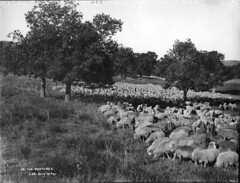
Image by Powerhouse Museum Collection via Flickr
Raising sheep on grass is common in Australia.


Editor's note: Today, I discuss grass-fed beef, lamb, milk, cheese and eggs, all of which are available in North Jersey.


The phrase "all natural" is thrown around with abandon, but there are no government or food industry standards to enforce it.


The best you can do is to look for meat and dairy products from animals that are treated humanely and raised on their natural diets -- free of antibiotics, growth hormones and animal byproducts.


Chief among them are pasture-raised Australian beef and lamb sold at ShopRite supermarkets, Costco Wholesale and other stores.


Unfortunately, labels carry little information on how cattle and sheep are raised in Australia, but ShopRite sales fliers call the beef -- sold under the Nature's Reserve brand -- "All Natural, Free Range, Grass Fed."


I was told by Meat and Livestock Australia Ltd. (MLA) that Nature's Reserve beef comes exclusively from cattle that are fed grass from start to finish. They are never confined to a feed lot, but they do receive some growth hormones.


The racks and boneless legs of lamb sold under the Costco label, Kirkland Signature, or sold without that label, such as the lamb osso bucco I saw last week in the Hackensack warehouse store, are from sheep raised in the same way-- except they do not receive any growth hormones.


Originally, MLA told me no growth hormones were used in beef sold under the Nature's Reserve label, but later corrected that.


Cattle and sheep stomachs are designed to turn grass into protein. When cattle are fed grain -- as the vast majority in the United States are to speed growth -- they can become sick. 


And the wide use of animal antibiotics is making humans resistant to prescribed antibiotics.


Nature's Reserve steaks, roasts and whole beef tenderloin for filet mignon are sold at ShopRite for about $6.99 a pound and even less when they are on sale. 


The meat is lean and contains beneficial Omega 3 fatty acids. It cooks quicker than conventional beef and is best when prepared medium rare.


I once saw grass-fed steaks from New Jersey on sale at Whole Foods Market in Paramus for $9.98 a pound, and the Fairway Market across town sold grass-fed, rib-eye steaks for $14.99 a pound and grass-fed burgers for $5.99 a pound in June 2010.


On Saturday, Costco's prices for Australian grass-fed lamb were $5.99 a pound for the boneless leg, $7.99 a pound for loin chops and $13.99 a pound for racks.  


Before I stopped eating meat nearly two years ago, the small lamb chops in the rack were my favorite. I would trim the rack and cut it apart, broiling the chops only until they were rare. They would literally melt in my mouth.


Of course, you don't taste the grass. But the meat is so pure and flavorful, compared to conventionally raised lamb, it needs little more than a bit of salt.


The current price of $13.99 a pound for a rack of lamb chops at Costco compares to the price I recall from a couple of years ago, $9.99 a pound.


The Australian whole beef tenderloin was ideal for slicing thin, marinating with Korean barbecue sauce and cooking quickly on a stove-top grill before wrapping the beef in red-leaf lettuce with rice, kimchi and garlic at the table.


Grass-fed beef and lamb are among several products from pasture-raised animals available in North Jersey.


Fairway Market sells milk from grass-fed cows. Trader Joe's has sharp cheddar cheese made with milk from pasture-raised cows in New Zealand ($5.49 a pound).


On Friday, for $5, I picked up two dozen Grade A Large Brown Eggs "from grass-fed hens with freedom in the field" at H Mart, the Korean supermarket in Englewood. The yolks are a healthy shade of yellow.


They are distributed by Swiss Villa LLC in Lykens, Pa., with a label that tells you the package is made from recycled PET, fewer than 350 hens forage on a pesticide-free acre of pasture "spring to fall," and the eggs come from "Swiss-peasant-descendant, small-scale farmers."


"You would enjoy seeing the hens scatter out over the pasture meadow each morning as dew droplets mirror the rising sun," the label says. 


I'm sure I would, as long as I was served a breakfast of their eggs right away.


Here are Web sites to help you find grass-fed meat.


Australian Lamb


The site lists Costco Wholesale and Stop and Shop supermarkets as sources of Australian lamb. Some brands to look for are Country Meadow Austral American Lamb and Opal Valley.


Australian Beef


ShopRite and Pathmark supermarkets in North Jersey are listed as sources.


Meat and Livestock Australia Ltd.


Meat and Livestock Australia is a marketing, research and development  agency that represents ranchers, processors, exporters and others involved in meat production in Australia.


To take a virtual farm visit in Australia, click on this link: 


On a Farm Down Under


Enhanced by Zemanta

Wednesday, December 8, 2010

When life gives you parsley ...

ParsleyImage via Wikipedia

I don't know why parsley keeps on growing in the boxes on my deck, despite temperatures that have dipped into the 30s overnight. But it's a nice, fresh addition to ingredients I buy for home-cooked meals.

Last week, I made a tabbouleh salad with flat-leaf parsley. On Monday, I made a frittata with lots of flat-leaf and curly parsley. This is what you'll need:
  • About two cups or more of chopped parsley.
  • Five eggs or the equivalent in egg whites.
  • Extra-virgin olive oil.
  • Salt, allspice and cumin to taste.
I mixed the chopped parsley and raw eggs with a little low-fat milk, and seasoned them with salt, allspice and cumin. I poured the mixture into a 10-inch, non-stick pan that I had heated up over medium heat with enough olive oil to coat the bottom.

When the bottom was set, I put the pan under the broiler for about 10 minutes, but I would suggest you watch it until the top sets. My frittata was runny, so next time I would cook it longer on the stove before moving it to the oven. 

I also added chunks of Swiss cheese to the egg mixture and, after I poured it into the pan, I put about 10 sun-dried tomatoes on top. I might make it without these additions next time or just use some cheese to give the frittata a little creaminess. 

My mother used to make small parsley or ground-meat omelets, fried in oil, to eat in pocket bread (each omelet contained about two tablespoons of egg mixture). 

In the summer, a sandwich of the small meat omelet, called egge (pronounced edge-eh), tasted especially good with a fat slice of Jersey beefsteak tomato.