Wednesday, February 10, 2010

Dog: 'Food is the least of our worries'

WARRINGTON, ENGLAND - JANUARY 04:  A seven wee...Image by Getty Images via Daylife


"Off The Broiler," the food blog written by my friend Jason Perlow, received a brief but telling comment on my blog -- "Do You Really Know What You're Eating?"-- from one of his readers, identified only as "dog."

Dog's thoughts on food
Reblog this post [with Zemanta]

Tuesday, February 9, 2010

Contradictons at Costco

Salmon farm in the archipelago of Finland
A salmon farm in Finland.
Image via Wikipedia


For about six months every year, Costco sells wild salmon and artificially colored farm salmon side by side. You'll also notice this in the chicken and meat sections -- organic poultry and organic or grass-fed meat mixed in with a much larger selection of their conventionally raised counterparts.

Yestersday, on my weekly visit to the Hackensack warehouse store, I saw a woman put a large tray of farmed salmon in her cart, and I asked her if she knew it is artificially colored. She thought the farmed salmon at Costco might be different, but it isn't. I told her she could find wild Alaskan sockeye salmon fillets in the freezer case and I have found that steaming them yields a fish that would fool many people into thinking it is fresh.

She also had one of the store's rotisserie chickens, which also are raised conventionally. The one time I asked the employee tending the rotisserie, he couldn't tell me anything about the chickens, inlcuding the brand. My frugal friend Jay, who has tried almost every rotisserie chicken in North Jersey, says the antibiotic-free, vegetarian-fed bird from Whole Foods Market in Paramus gets the crown.

Yesterday, I saw Coleman-brand organic skinless and boneless thighs at Costco, but they were in pouches -- not one of those foam trays -- and when I picked them up, the feel of the formless meat was unpleasant and I didn't buy any.

The contradictions continue throughout the store. At Christmas,  I was all set to buy the first Costco ham raised without antibiotics or growth hormones, but when I looked at the label, it listed harmful preservatives used in curing. I would have bought an uncured ham. Most of the cold cuts offered also have sodium nitrates or nitrites as preservatives, though I have noticed expensive imported prosciutto without them.

Though they are pricier, wild fish and organic poultry taste better.This morning, I used part of a frozen wild salmon fillet I had steamed for dinner last night in my breakfast sandwich, stacking it with Costco's smoked wild salmon, herbicide-free tomato slices and organic lettuce. I also used Dijon mustard, though pesto or hummus would have tasted good, too, as would have a slice of Swiss or shavings of Parmigiano-Reggiano cheese. (Sockeye salmon is shown).


Sockeye salmon
A sockeye salmon.
Image via Wikipedia


With the sandwich, I had some lemony, Hannah-brand taboule salad from Costco ($4.99 for 21 ounces), a relatively new item, and Arirang kimchi, an MSG-free brand made and sold in Englewood. Costco recently put out jars of kimchi, but unfortunately, they are made with monosodium glutamate, and it's not worth the couple of dollars I would save.


Enhanced by Zemanta

Monday, February 8, 2010

Farmers' Market bargains (revisited)

Stonyfield Farm is an organic yogurt maker loc...Image via Wikipedia


In my previous post on the Paterson Farmers' Market, "Follow the tracks to great food buys," I forgot to list another Stonyfield Farm yogurt item on sale at Eastern Groceries -- an 8-pack of organic YoKids Squeezers for $1.

And I was mistaken when I said the expiration date of the Earthbound Farm organic heirloom lettuce leaves was in four days (Feb. 10). That was the case for the organic spring mix I saw there, but when I went to use the lettuce last night, I saw the expiration date was Jan. 30.

Still, they made a beautiful salad last night and I used them again in breakfast sandwiches this morning. Unlike the more delicate spring mix beyond the expiration date, the lettuce showed no signs of deterioration and I plan to buy more in the future ($1 for 7 ounces).

Reblog this post [with Zemanta]

Sunday, February 7, 2010

Beans, beans and bread

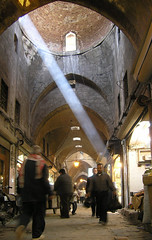
souq, aleppo syria, easter 2004Image by seier+seier+seier via Flickr


My passion for the spices and flavors of the Middle East only seem to increase as I get older. I have been trying more and more to experience again the wonderful meals I enjoyed for many years at my mother's table -- her Jewish specialties from Aleppo, Syria, where she was born.

Now, I visit Aleppo Restaurant and Middle Eastern bakeries and markets in Paterson to taste that wonderful food or gather the ingredients for home-cooked meals.

The other day, I found a large, 32-ounce can of fava beans from Lebanon in my cupboard and immediately thought salad. I drained most of the liquid and poured these humble beans into a bowl, adding chopped scallion and parsley, extra-virgin olive oil, juice from two small lemons, garlic powder, cumin, allspice, Aleppo red pepper and salt.

You can heat up the seasoned beans, smash some of them and serve them with a hard-boiled egg on top. Or you can spoon a good amount of beans on a plate, warm them in the microwave and top them with one or two sunny side up eggs, as I did for breakfast today. Then, I warmed up Syrian bread and scooped up egg, yolk and beans, or made small sandwiches with the pocket bread.


Photo de falafels Photo prise par Jerem ja:画像:...Image via Wikipedia
Grace Sasson, my mother, used to make falafel with fresh fava beans, as the Egyptians do. Everyone else uses chickpeas. In her self-published cookbook, "Kosher Syrian Cooking," she has the falafel recipe and a second recipe where shelled fava beans are cooked in oil, water and allspice until they turn brown and served as a side dish.

I'll probably be making some hummus (pureed chickpeas) this week -- adding powdered garlic, lemon juice and olive oil to canned spread from Lebanon -- and I know I'll be snacking on pocket-bread sandwiches of fava beans and hummus. Basic, filling and delicious.

Reblog this post [with Zemanta]

Saturday, February 6, 2010

Follow the tracks to great food buys

City of PatersonImage via Wikipedia


I've enjoyed shopping and eating in Paterson's Middle Eastern food bazaar for nearly 30 years, but haven't paid much attention to the city's bustling, year-round Farmers' Market.

Today, I met Chuck, one of my loyal readers, at the market on East Railway Avenue and he led me to some remarkable food bargains, most of which are gone by Sunday. Besides produce stores, there are butchers, a fish market, restaurants and non-food merchants. Parking is free.

My first stop was Eastern Groceries Inc. at 459 E. Railway Ave. (look for the number, the name on the door says something else). None of the following prices are typos.


USDA Organic LabelImage via Wikipedia
 I picked up a dozen 5.3-ounce cups of Stonyfield Farm organic, fat-free Oikos, Greek-style yogurt for $2 -- that's less than 17 cents each. They were stamped with a date of Feb. 8, meaning we will have about two weeks to finish them. A simple drizzle of honey turns this yogurt into a great dessert.

Earthbound Farm organic heirloom lettuce leaves were $1 for 7 ounces -- or $2.28 a pound. Organic spring mix was $1.99 for 12 ounces -- or $2.65 a pound -- far less than at Costco. Both had use-by dates of Feb. 10. A 5-pound box of Spanish clementines was $3.49 -- by far the lowest price of the season.

A 1-pound package of large, Sunset-brand, herbicide-free tomatoes was $1.50. A bunch of radishes was 50 cents. I had to pass up a lot of  other bargains -- my refrigerator and freezer are bulging as it is. 

Despite the sub-freezing weather, there was a beautiful display of produce outside Brother's, 327 E. Railway Ave., but all I needed were lemons (four for $1). Olives are only $1.99 a pound. This store also carries a good selection of Middle Eastern food, such as imported tahini sauce, fava beans, hummus and so forth.

Then I drove over to Main Street, lined with Turkish and Middle Eastern restaurants, shawarma shops and markets, to shop at Nouri's and Fattal's bakeries, two longtime Syrian rivals I have patronized for decades.They are at 999 and 975-77 Main St., respectively, and both have their own parking lots and carry so much more than just bread.

View of Paterson New Jersey 1880.Image via Wikipedia

At Nouri's, I found three liters of Greek extra-virgin olive oil for $17.99, among bottles and tins  from Syria, Lebanon and Turkey. At Fattal's, I picked up five cans of Moroccan sardines in spicy oil at 99 cents each and large, store-made spinach pies ($8.99 for six).

A big thank you to Chuck.

Friday, February 5, 2010

A good fish story

Whole Foods MarketImage via Wikipedia


I've always been told to choose wild seafood over their cousins raised down on the farm, but Whole Foods Market has adopted standards for farmed seafood that make those fish and shellfish a lot more attractive. I often eat seafood out when I'm not offered naturally raised beef, pork, lamb or poultry.

You can read the whole story here:
'Responsibly farmed seafood'

Whole Story, the Whole Foods Market blog, is now available on my blog list.
Reblog this post [with Zemanta]