Showing posts with label farmed Atlantic salmon. Show all posts

Tuesday, August 18, 2015

You can enjoy perfectly grilled, juicy wild salmon in only 6 minutes

Fresh wild sockeye salmon from Costco Wholesale spends only 6 minutes on a preheated stove-top grill. Here, I served it with Costco pesto and organic salsa, as well as chopped mint and other herbs from our garden.


By VICTOR E. SASSON
EDITOR

We cook fresh wild salmon at home nearly every week during the season, which runs from June to October at Costco Wholesale in Hackensack.

A friend who just returned from a vacation in Alaska reported rivers are thick with salmon struggling to swim upstream and lay their eggs.

The price of fresh wild sockeye fillets has fallen steadily since June, and I've learned a thing or two about cooking this wonderful fish on a preheated stove-top grill.

For one thing, I was cooking the fillets too long -- 8 minutes to 10 minutes.

I reduced the cooking time to 6 minutes, and they came out juicier.

The longer cooking time is appropriate for wild king salmon fillets, which are thicker than sockeye.

Wild sockeye fillets are thinner and smaller than both king and Costco's artificially colored farmed Atlantic salmon, which are probably raised on antibiotics.

I usually get six serving pieces from about 2 pounds of wild salmon, and add sea salt and fresh lime juice before arranging the pieces skin-side down on the large, rectangular preheated grill.

The All-Clad Grill is 20 inches long and 13 inches wide, and the fish cooks best at both ends -- over the burners.

Quick dinners

Besides quick-cooking wild fish, my strategy for putting a meal on the table in less than 10 minutes includes making such side dishes as quinoa, brown rice, pasta and baked or mashed sweet potatoes in large quantities.

Then, you can plate and reheat some, add your wild salmon, enjoy dinner and finish with a big salad of Earthbound Farm Organic Spring Mix, also from Costco. 

In the morning, two organic eggs, sunny side up, are wonderful over sweet potatoes mashed with extra-virgin olive oil, especially when you break the yolks over them.


The All-Clad Grill I use straddles two burners of my stove. I preheat it, use spray oil and turn the heat on both burners to medium-high before adding the fish, skin-side down. After 3 minutes, I turn the pieces, and then again onto the skin for the last minute. If you're serving the salmon with ripe peach halves, grill them first, because they need much more time.

A package of 2 pounds of Fresh Wild Sockeye Salmon yields about six serving pieces.
An electric cooker full of organic brown rice, organic diced tomatoes, low-sodium red beans and chopped fresh garlic, prepared with extra-virgin olive oil. The leftovers allow you to put dinner or breakfast on the table in minutes.

Friday, August 14, 2015

Costco egg whites and fresh blueberries are up, wild salmon is down

Medium-spicy Kirkland Signature Organic Salsa, a new item at Costco Wholesale, tastes great, judging from a free sample I tried in the Hackensack warehouse store today. Each of the two jars holds 2 pounds 6 ounces of salsa ($7.89).


By VICTOR E. SASSON
EDITOR

Tens of millions of egg-laying chickens caught the flu and farmers killed them, raising the price of eggs, according to news reports last month. 

At Costco Wholesale in Hackensack, the impact has varied:

Kirkland Signature Egg Whites (six 16-ounce cartons for $9.99) were replaced by Egg Beaters, the same 100% pure egg whites, but members now get only four 16-ounce cartons for $8.99.

Meanwhile, the price of cage-free Kirkland Signature Organic Eggs doesn't seem to have been affected (two dozen whole eggs for $6.99).


Egg Beaters replaced Kirkland Signature Egg Whites.

Two organic eggs from Costco Wholesale made for a hearty breakfast over organic whole wheat pasta with sardines and chopped garlic. The price of organic whole eggs hasn't been affected by avian flu.


Blueberries and wild salmon

On Wednesday, my wife came home with an 18-ounce package of fresh blueberries from Michigan for $4.99, compared to a 32-ounce package of Jersey blueberries she bought at Costco a couple of weeks ago for $5.99.

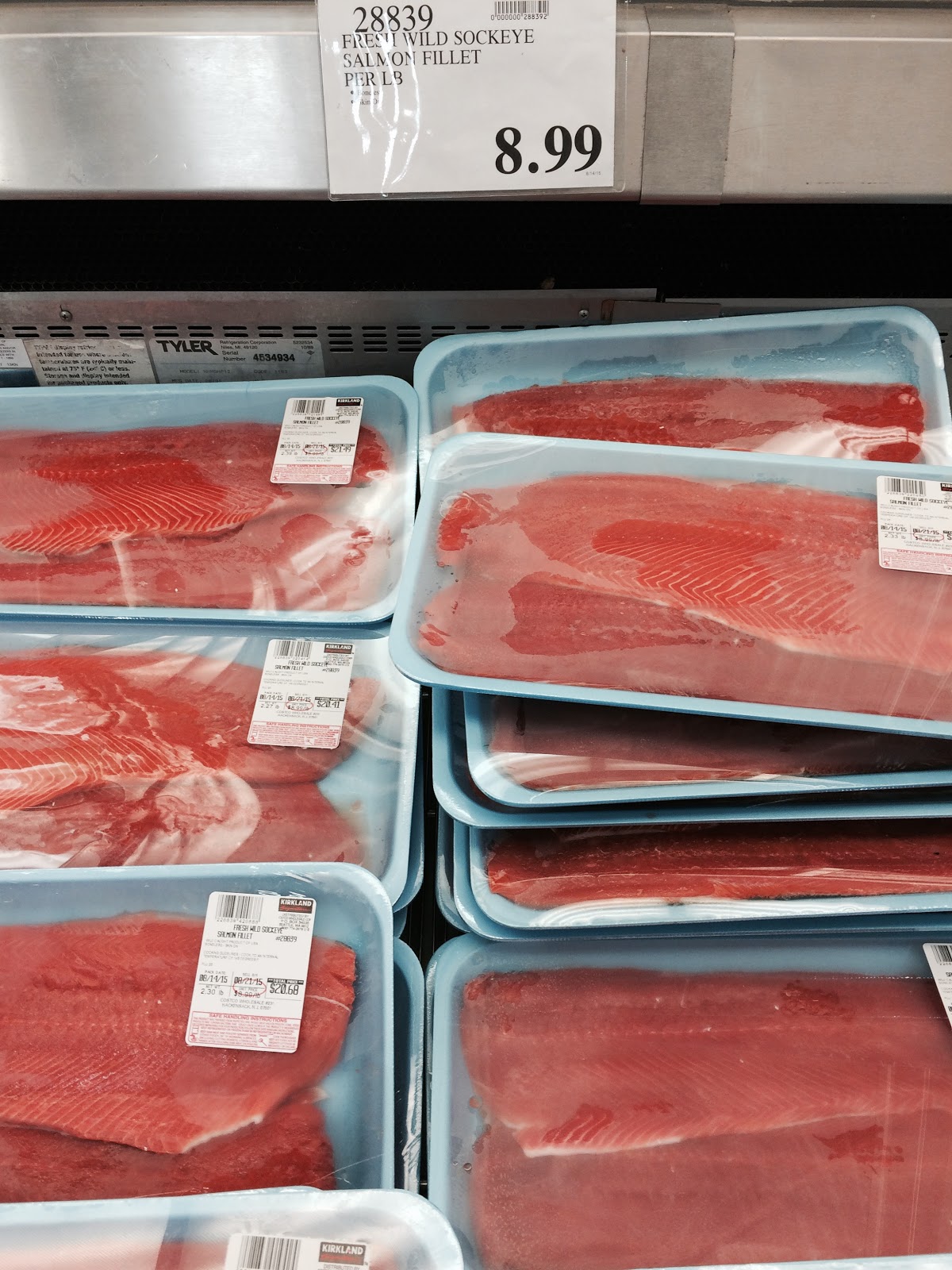
But Costco has again reduced the price of fresh wild sockeye salmon fillets, this time to $8.99 from $9.99.

Tonight, I plan to grill the salmon on the stove top with a little sea salt and fresh lime juice, and serve it with Kirkland Signature Organic Salsa and Kirkland Signature Basil Pesto.


Now, fresh wild sockeye salmon fillets are $8.99 a pound, only $2 more a pound than artificially colored farmed Atlantic salmon, below.


Tuesday, June 10, 2014

Costco Wholesale celebrates wild salmon from Alaska's Copper River

Fresh wild sockeye salmon from the Copper River in Alaska with diced organic tomatoes, red wine, extra-virgin olive oil, garlic, fresh oregano and fresh mint. The side dish, top, is organic baby spinach sauteed with chopped garlic, chicken stock and sake.

At Costco Wholesale in Hackensack on Monday, comparing the natural color of wild Copper River sockeye salmon, bottom, and artificially colored farmed Atlantic salmon. The wild fish also tastes more robust.


By VICTOR E. SASSON
EDITOR

The June 2014 edition of the Costco Connection magazine tries to answer salmon lovers' questions about why sockeye from the Copper River in Alaska are held in such high regard.

The Copper River isn't the longest salmon river in the world, but it probably has the best marketing.

"The Copper River is a very fast-moving glacial river, so the salmon have to store up a lot of oil content to get up the river," said Scott Blake, CEO of Copper River Seafoods (Pages 48-9).

"If you look at other river systems, they're very short in comparison, so salmon that go into those rivers don't produce [as much] oil," Blake added.


Kirkland Signature Wild Alaskan Smoked Sockeye Salmon from Costco Wholesale on an egg-white omelet with Aleppo pepper and Kirkland Signature Basil Pesto, also from Costco. 

One of year's first runs

The seafood executive says the Copper River has other advantages:

"It has one of the first commercially harvested salmon runs of the year in Alaska, so it's available before other wild salmon hit the market; and Copper River's location near a port and proximity to Seattle make fast transportation plausible," Blake says.

"Today, Copper River salmon fetch some of the market's highest prices, making it a cornerstone of the Alaskan economy," according to the Costco members' lifestyle magazine.

Copper River salmon gained its ascendancy in the late 1980s, when Jon Rowley, a Seattle-based seafood and marketing consultant, introduced the fish and their fishers to high-end restaurant owners and chefs, the magazine notes.

In 2013, commercial fishers pulled 1.8 million coho, sockeye and king salmon from the Copper River, which is nearly 300 miles long, according to Alaska fish and game officials.


Salmon prices at Costco

Now, fresh Copper River sockeye fillets are selling at the Hackensack warehouse store for $14.99 a pound, twice the price of artificially colored farmed Atlantic salmon.

But that's only $1 a pound more than they were selling in June 2012.

On Monday, we picked up a package with two sockeye salmon fillets weighing a total of 2.10 pounds that yielded about eight serving pieces, enough for four with leftovers.

I roasted the relatively thin serving pieces for 12 minutes in a 375-degree oven, and they were cooked medium.

I topped them with a reduced mixture of organic diced tomatoes, garlic, red wine, lime juice, extra-virgin olive oil and fresh oregano, then added chopped fresh mint.


A breakfast of Copper River sockeye salmon with a wedge of cheese-and-garlic frittata, and mashed sweet potatoes. For dinner tonight, half of a piece of leftover salmon was delicious eaten cold over an organic spring mix salad.

Three recipes

The Costco magazine article includes three recipes, Ceviche-Inspired Wild Alaskan Salmon, Lomi Lomi Salmon and Southeast Grilled Salmon.


Monday, August 10, 2009

'Why is it so red?'


On my weekly trip to Costco in Hackensack today, I was fishing for another fillet of the fresh, wild sockeye salmon I have been enjoying for a couple of months ($8.99 a pound). "This is really good," I said to the woman next to me, referring to the salmon. "Why is it so red?" she replied.

I pointed to the word "wild" on the sign and tried to explain deep orange-red is the natural color. I don't think I got through to her. Not far away were shrink-wrapped packages of farmed Atlantic salmon whose artificial color is pale by comparison. This is the color people have become used to associating with salmon.

I've read that salmon farmers are shown a color palette and that the feed is then tailored with chemicals to produce the desired color. Wild salmon, on the other hand, get their color from a natural diet of shrimp and krill, which contain beta carotene.

I'll cut my wild salmon fillet into five or six portions; season it with salt, Aleppo red pepper and fresh, chopped oregano; and bake it for 10 to 12 minutes at 350 degrees for medium rare. I can't wait for dinner.