Showing posts with label Mohamed K. Jello. Show all posts

Friday, June 24, 2016

As thousands were fasting, I enjoyed a filling Syrian lunch in Paterson

At Aleppo Restaurant in Paterson, an appetizer spread called Muhammara is made from a red pepper that has been described as having "a vivid taste, sweet and smoky and faintly pungent" ($6).

Meat Arayes, another appetizer, invites you to add Muhammara and Hummus spreads to the seasoned beef inside the toasted pocket bread ($6).


By VICTOR E. SASSON
EDITOR

You can have Paterson's bustling Middle Eastern bazaar pretty much to yourself during the holy month of Ramadan.

On a sunny and hot Tuesday afternoon, there was barely any foot traffic on Main Street in South Paterson, but Muslim and Christian merchants kept their restaurants, bakeries and produce markets open.

Outside some restaurants, banners advertise Ramadan Buffets.

Customers paying for their purchases at Brothers Produce on East Railway Avenue see a sign wishing them "Happy Ramadan."

At Aleppo Restaurant on Main Street, owner Mohamed K. Jello (pronounced JILL-lo) said he has been fasting from 4 a.m. to 8 p.m. each day, then filling his tables with customers who clamor for his Syrian specialties, including a special dish made with quince.

"I'm feeling a little woozy," he said after handing menus to me and my son, and noting he is forbidden to eat or drink water and coffee during the fast.

It doesn't seem fair that Orthodox Jews only have to fast on one day each year while Muslims fast for 30 days during Ramadan, which ends this year after sundown on July 5.


Aleppo's peppers

In a February 2010 review, David Corcoran of The New York Times noted the restaurant is named after the city of Aleppo, a major stop on an ancient trade route.

"The city gives its name to a red pepper with a vivid taste, sweet and smoky and faintly pungent," Corcoran wrote.

Then -- before the civil war destroyed large parts of the city -- one of Mohamed Jello's daughters dried Aleppo peppers "on the sun-washed roof of her house, preserves them and sends them to Paterson."

"The chef takes it from there, mincing them to a fine dice and whipping them with chopped walnuts, olive oil and spices into a vibrant, stop-sign red version of the appetizer spread called muhammara."

The red-pepper spread is the spiciest dish to emerge from the Syrian kitchen, where much of the food is prepared with tamarind, anise-like licorice root, lemon, fresh parsley, cumin, garlic, allspice and other aromatic seasonings. 


A freshly made Arabic Salad is lightly dressed in olive oil, lemon juice and chopped parsley ($5).

Hummus gets a drizzle of olive oil, a dusting of ground Aleppo pepper and cumin, and chopped parsley ($5).

A small plate of pickles and a basket of pocket bread for scooping up spreads are complimentary.

Turkish coffee ended our filling lunch.

The 60-seat dining room is filled at 8:30 p.m., when Jello serves Muslims who are ending their daily fast during the holiest period on their calendar. Two flat-screen TVs broadcast live from Mecca, the holy city in Saudi Arabia. Ramadan is said to be the month in which the Quran was revealed to the Prophet Muhammad.

Aleppo's menu includes more substantial fare, including whole red snappers, kebabs and other entrees. The restaurant is at 939 Main St. in Paterson at Thomas Street; 1-973-977-2244. Open daily.

In the Paterson Farmers Market, Brothers Produce at 327 E. Railway Ave. appears to have doubled in size, and now has nine checkout lanes to handle the crush of customers -- three times as many registers as before.

The popular store also has a second, much larger parking lot across Knickerbocker Avenue.

Brothers Produce is open daily; 1-973-684-4461.

Friday, February 12, 2016

Shopping for comfort food in Paterson, I can't help but cry for Aleppo

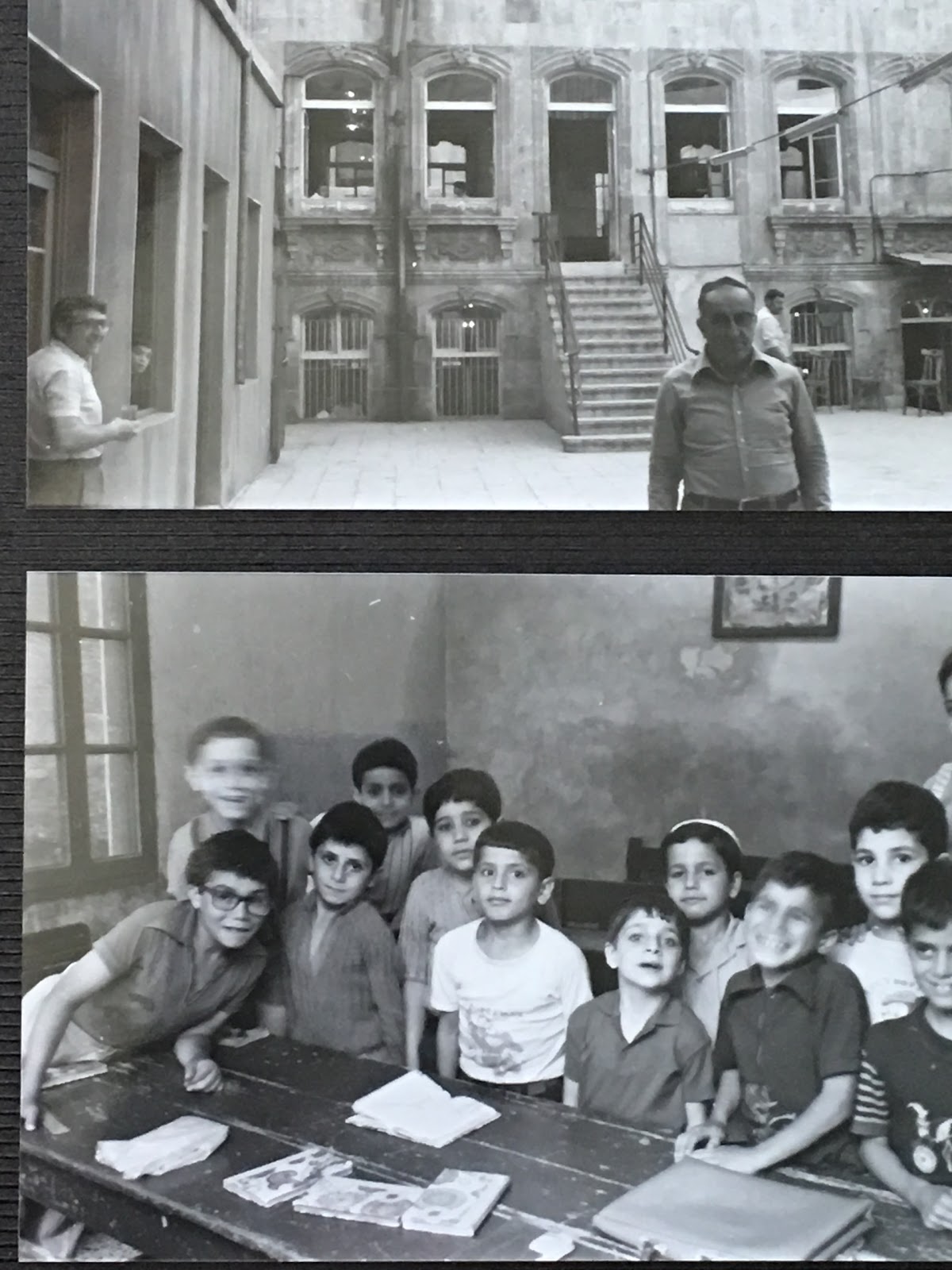
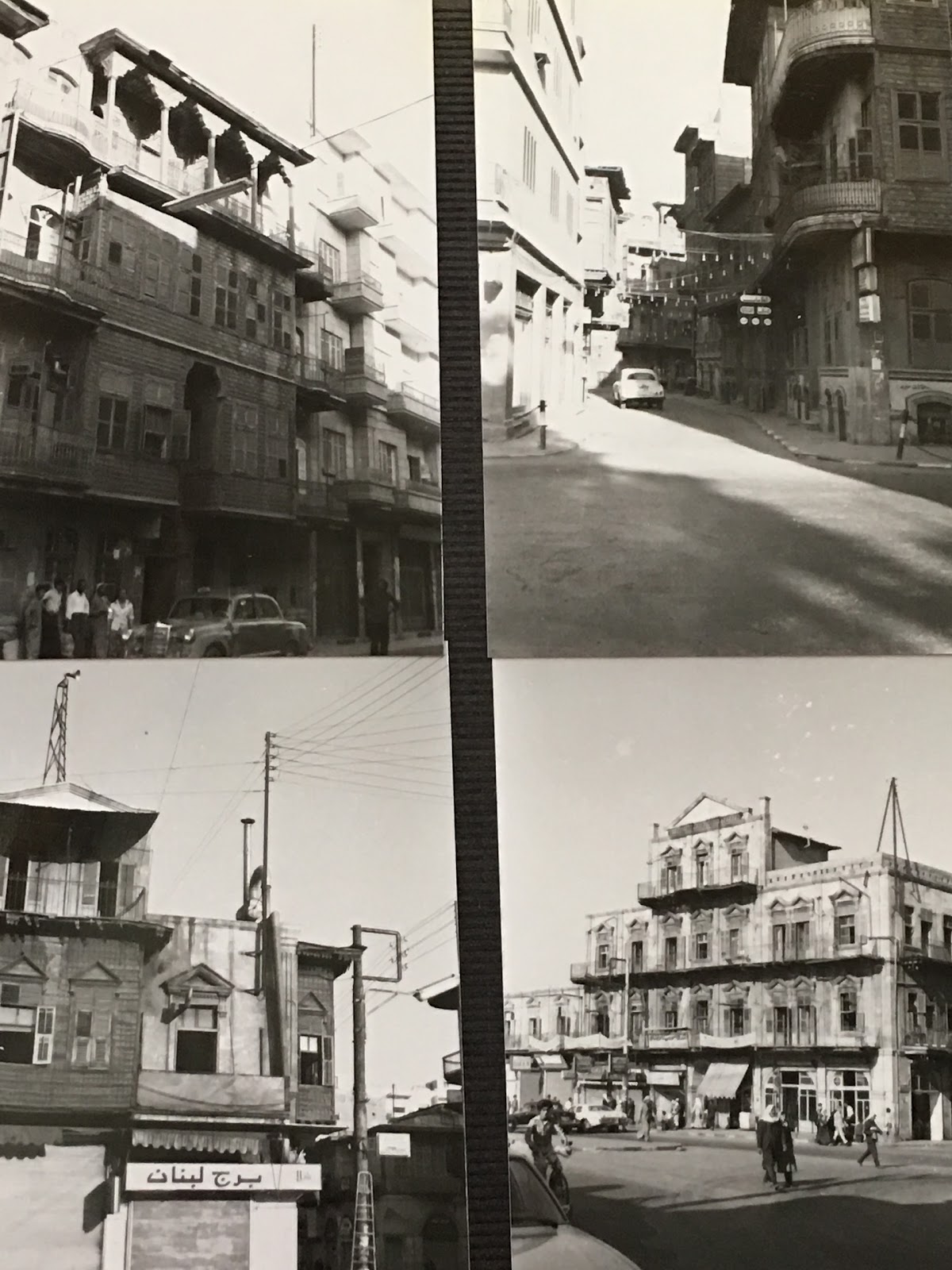
In June 1978, I made a brief visit to Aleppo, the city in the north of Syria where my parents were born. I saw many things and places familiar from the conversations I overheard when my parents invited their many friends to our house in Brooklyn, and I took lots of black-and-white photos. Here, Syrian bread puffed up like a pillow as the loaves baked in an oven before being offered for sale.
In the summer of 1978, you could stop on the streets of Aleppo for a cup of hot tea or a yogurt drink.

Editor's note: In 2013, I described my emotions after I heard the news about a government assault on Aleppo, Syria, the city where my parents were born. Now, the situation has gotten even more hopeless.

By VICTOR E. SASSON
EDITOR

Since the start of the Syrian civil war, my occasional trips to buy bread, spices and other food in Paterson's Middle Eastern bazaar have been anything but routine.

I'm a first-generation American born to Jewish parents who emigrated from Aleppo, Syria, in the 1920s.

This week, government forces, backed by the Russians, began an offensive to take back Aleppo from the rebels -- a development that once again turned my thoughts to the city of their birth and its rich food tradition.

Today, The New York Times, quoting a new report, said 470,000 Syrians have died in five years of war -- almost twice the 250,000 counted a year and a half ago.

If that doesn't bring tears to your eyes, I'm not sure what would.


In 1978, I visited a Jewish yeshiva in Aleppo, and met teachers and an excited group of students.
Jewish life

My father's father was a pastry maker in Aleppo, and my mother's father was a rabbi and shochet, who was certified as competent to kill cattle and poultry in the manner prescribed by Jewish law.

My parents met on Manhattan's Lower East Side, married, sailed to Cuba for their honeymoon on the Morro Castle, and eventually settled in Brooklyn, where my mother self-published the first edition of her Syrian Jewish cookbook in the 1950s.

When I moved to northern New Jersey in the late 1970s, I began visiting Paterson to shop or eat in bakeries, markets and restaurants opened by Syrian Christian immigrants in the South Paterson neighborhood bordering Clifton.

They began arriving in the late 1800s and early 1900s to work in the city's silk mills.


In 1968, Michael Fattal, a baker from Aleppo, opened Fattal's in Paterson. Today, you can find hundreds of items, including store-baked spinach pies, pastry, cheese, yogurt drinks, imported extra-virgin olive oil, spices, tea and chewy pocket bread, or order a Syrian specialty and enjoy it in a small dining area at the back of the greatly expanded bakery, butcher and grocery store.
A mildly spicy Aleppo pepper is the perfect accent for fish and egg dishes or you can use a pinch or two when making hummus.


Fattal's on Main Street

My first stop on Thursday was Fattal's, one of the few South Paterson businesses with is own parking lot.

I made the trip because I had nearly run out of crushed red Aleppo pepper, which I sprinkle liberally on fish and egg dishes.

I bought a little more than a half-pound of crushed pepper ($6.99 a pound), a quarter-pound of ground cumin ($4.99 a pound), and a pound of Fattal's own grape leaves stuffed with vegetables ($7.99 a pound).

A 3-liter bottle of La Ziza Extra Virgin Olive Oil from Lebanon was $20.99 or just under $7 a liter. A half-gallon of Merve Ayran Yogurt Drink was $10.29.

A half-dozen freshly baked Spinach and Cheese Pies were $8.99, and 13-ounce cans of Libano Verde Hommos Tahina from Lebanon were 99 cents each.


Easy hummus

All you need to do make creamy hummus is empty the contents of a can into a bowl, and add fresh lime juice, extra virgin olive oil and plenty of minced or ground garlic to taste.

I garnish hummus with Aleppo pepper, crushed mint leaves or both.

In Paterson, after dashing over to Salah Edin, a restaurant on the next block, for two bags of freshly fried falafel, I went back into Fattal's for a package of medium Syrian breads (12 for $1.50), the only ones I could find without preservatives.


South Paterson

Even as Aleppo is being slowly destroyed, South Paterson is prospering, with the opening of new cafes, pastry shops and restaurants.

Over the years, Syrian businesses have been joined by numerous Turkish, Lebanese and Palestinian cafes, bakeries and restaurants. 

A new strip mall has opened on Main Street, and a new building is going up near Salah Edin Restaurant.

The big farmers' market off of Crooks Avenue is open year-round. And a large McDonald's has opened on the Paterson side of Crooks Avenue.


At Salah Edin, $1 buys a bag of five freshly fried falafel.

On the drive home, the smell of fresh Fattal's bread teased me. At my kitchen counter, I immediately made and ate two small sandwiches with hummus, one with a cold stuffed grape leave and the other with a warm falafel, above and below.

Fattal's bread keeps beautifully in the refrigerator or freezer.
The dining room of Aleppo Restaurant at Main and Thomas streets in Paterson.

What's still standing

On Thursday, I put my groceries in the car, left it parked in Fattal's lot, and walked two blocks to visit Mohamed K. Jello, a devout Muslim who owns Aleppo Restaurant.

The terrific Syrian food there reminds me so much of my mother's cooking.

I embraced Mohamed, and he served me a glass of hot ginger tea.

He said relatives still are living in the northern part of the city, and so far are safe.

We talked about the destruction of the minaret in the Great Mosque, but he said the old clock tower is still standing.

Click on the following link to my 2013 post on Aleppo, written almost 35 years to the day after my 1978 visit.

See: My heart goes out to Aleppo, Syria


Details

Fattal's, 975-77 Main St., Paterson; 1-973-742-7125.

Aleppo Restaurant, 939 Main St., Paterson; 1-973-977-2244. No alcohol allowed.

Salah Edin Restaurant, 995 Main St., Paterson; 1-973-225-0575.

In 1978, a clock tower known as Bab al-Faraj was a major landmark in Aleppo, and I often heard it referred to when my parents and their friends reminisced about their lives in the city, said to be the oldest in the world. 
The minaret of the Great Mosque of Aleppo, shown in June 1978, was destroyed during fighting in April 2013. The building dated to the 11th through 14th centuries.
In 1978, I explored the cobblestone streets and alleys of Aleppo's old city, where I was surprised to see Star of David motifs in a metal door, upper left.
Even in 1978, parts of the old city were being cleared for the construction of apartment buildings, above.
Residential buildings in Aleppo near the clock tower.
Stalls selling brooms.
A March 2015 report on The Guardian.com said troops loyal to President Bashar al-Assad were using the ancient citadel of Aleppo to rain down destruction on enemies below, and that the 13th century fortress had suffered "untold damage."

Sunday, September 6, 2015

In Paterson, $1 bag of falafel is not as big of a bargain as it once was

The window of a Syrian wedding shop on Main Street and Gould Avenue in Paterson's South Paterson neighborhood, above and below.


By VICTOR E. SASSON
EDITOR

The parking lot of Fattal's was far from full today, so I'm sure no one noticed me in my car when I ripped open a plastic bag, tore off a piece of whole-wheat pocket bread, wrapped it around a hot falafel ball and ate it.

At home, I ate two more still-warm falafel in the same thin, Lebanese-style bread with garlicky hummus I made the day before from a can I bought at Fattal's on a visit in April.

But when I emptied what was supposed to be two paper bags, each with seven falafel, into a storage container, I came up short.

It turns out Salah Edin, a Middle Eastern restaurant near Fattal's in Paterson, has reduced the $1 bag of falafel to five from seven.

That's still a good deal, and the ground-chickpea falafel are beautifully fried and greaseless.

At Fattal's, I bought two dozen cans of Al Shark-brand Moroccan Sardines in Tomato Sauce (99 cents each), and a package of Fattal's large homemade Spinach Pies (six for $8.99).

At Nouri's, 999 Main St., I bought a package of medium, Lebanese-style whole-wheat pocket bread for $1.25.

Salah Edin is at 995 Main St., and Fattal's is at 975-77 Main St.


At home, we keep cans of Moroccan Sardines handy to add to bottled pasta sauce when we prepare organic whole-wheat fusilli, shells, spaghetti and other shapes. The whole-wheat pastas are available at ShopRite, Whole Foods Market and Trader Joe's for $1.25 to $1.49 a pound.

Nostalgic for the past

Visits to the bustling Middle Eastern bazaar known as South Paterson once were filled with memories of the family meals of Syrian food my mother prepared every night in Brooklyn.

Now, all I can think about are the horrors of the civil war in Syria, where the brutal Assad regime indiscriminately bombs civilians.

I stopped into Aleppo Restaurant on Main and Thomas streets, to say hello to the chef and owner, Mohamed K. Jello.

The restaurant is named for the northern Syrian city where my parents were born.

While I was waiting for Mohamed to return from shopping for the restaurant, I spoke to an employee who was enjoying a bowl of ful mudammas or fava beans in sauce for breakfast.

He said the media have drastically under-reported the number of people killed during the Syrian civil war.


Libano Verde Hommos Tahina from Lebanon allows you to make your own at home by adding lemon juice, garlic and extra-virgin olive oil. The can for 99 cents, right, once 15 ounces is now only 13 ounces.

To make hummus from a can, I used fresh lime juice, finely chopped fresh garlic and extra-virgin olive oil, all to taste; chopped fresh mint and Aleppo pepper.


In April, five of the seven falafel for $1 at Salah Edin Middle Eastern Restaurant were still warm when I got them home, above. Now, you get five falafel for $1.

Salah Edin in April. Today, I walked past before I realized the restaurant had removed its sign in anticipation of getting a new one on Tuesday.

Kings Whole Wheat Pita is baked in Paterson without preservatives, but I couldn't find the thin, Lebanese-style loaves today at Fattal's or Nouri's, two Syrian bakeries on Main Street that have competed for decades.

Fattal's is a combination Syrian bakery, butcher, grocer and small cafe, with its own parking lot, at 975-77 Main St. in Paterson. The store also sells gold bracelets and necklaces, and other jewelry.


Saturday, July 26, 2014

You won't find any white knights at Al Cavaliere Ristorante

Al Cavaliere Ristorante in Clifton promises "Italian Gastronomy," but you might get a big helping of agita instead.


By VICTOR E. SASSON
EDITOR

I had my heart set on hearing the Heath Brothers Quintet at William Paterson University on Friday night.

And on the way to Wayne, dinner at a fine-dining Italian restaurant sounded like the perfect appetizer for a jazz concert.


In June, I had purchased an Amazon Local voucher for $15 that entitled me to spend $30 on food and drink at Al Cavaliere Ristorante on Piaget Avenue in Clifton ("The Knight" in English).


Sorry, Charlie

But when I arrived at the restaurant on Friday evening, I got an argument instead of the house salad and grilled fish I had planned to order. 

The waiter who greeted me saw the voucher in my hand, and when I said, "One for dinner," he quickly informed me that to use the discount, I would have to order "two entrees."


He said that was "restaurant policy," even though it isn't one of the conditions listed on the voucher.


When I asked to speak to the manager -- a potential white knight-- the waiter said he was on vacation, and a second server backed him up.


Only two of the tables in the dining room, which seats 65, were occupied.


I call Amazon Local

I sat down in the waiting area and called Amazon Local Customer Service, where Kim said that if she couldn't talk to the manager, she could offer me a refund, which I accepted.

I called back this morning, and Fez, another Customer Service representative, said merchants approach Amazon and voluntarily issue vouchers in an effort to increase their business.

Merchants are "vetted" to see if they are appropriate to advertise on Amazon Local.

He added Al Cavaliere Ristorante won't be "allowed to get away" with how I was treated.

On Friday evening, when I was turned away, I asked the waiters at Al Cavaliere if there was another restaurant nearby, and one of them suggested a White Castle.


The simple but filling meal I was served at Aleppo Restaurant in Paterson, above and below, after I was turned away by Al Cavaliere Ristorante in Clifton. The salad dressing included dried mint.


South Paterson

Instead, I took Main Avenue in Clifton to the South Paterson section of Paterson, where I stopped at Fattal's (975-77 Main St.) for 18 cans of Moroccan sardines at 99 cents each and a 3-liter bottle of extra-virgin olive oil for $13.99.

A couple of blocks away, I found owner Mohamed K. Jello in the dining room of Aleppo Restaurant at Main and Thomas streets, where he was fasting for the Muslim holiday of Ramadan.

He served me hummus, salad, water and strong Turkish coffee while we caught up.


Summer Jazz Room

I got to the WPU jazz concert in plenty of time, and bought a ticket for $8 (with a senior discount).

Tenor saxophonist Jimmy Heath led his group with a guest trumpet player in his own compositions as well as on "'Round Midnight" and other classics.

It was a rousing concert, and the group got a standing ovation. 

So the evening wasn't a total loss despite the rude and inconsiderate behavior of the staff at Al Cavaliere Ristorante.


Sunday, June 16, 2013

My heart goes out to the city of Aleppo, Syria

Grilled whiting fillets at Aleppo Restaurant, whose owner is from the northern Syrian city that is reportedly bracing for an assault by government troops. After an early dinner at the Paterson restaurant on Saturday, we drove over to the Great Falls, which was swollen by recent heavy rains, below.
Paterson's Great Falls.

A photo I took in 1978 shows a Star of David motif on Bab Al Faraj, a clock tower in Aleppo, Syria.


By VICTOR E. SASSON
EDITOR

News of a planned Syrian-government assault on rebel-held Aleppo flooded me with memories of my 1978 visit to the city where my Sephardic Jewish parents were born.

Growing up in Brooklyn, N.Y., I was constantly reminded of Aleppo -- from the Arabic records my mother played to the wonderful meals of Syrian specialties she prepared every day.

My parents, who spoke Syrian at home, often discussed Aleppo and such landmarks as Bab Al Faraj, a clock tower at one of the entrances to the old city.

Since the battle for Syria began more than 2 years ago, I've often wondered whether the clock tower and the other buildings I saw on my visit 35 years ago are still standing.

Now, my heart breaks at the thought of more death and destruction in Aleppo.

The city -- 186 miles north of Damascus -- was big in my parents' day. In 2005, it had a population of 2.3 million and was the largest city in Syria.

On Saturday, I planned a day of food shopping and sightseeing in and around Paterson, a city whose silk mills drew thousands of Syrian immigrants in the early 1900s.

Along with my wife and mother-in-law, I stopped for an early dinner at Aleppo Restaurant on Main Street, trying to recapture the flavors of my mother's dishes, as I have for the many years I've lived in northern New Jersey.

The food always brings me back to Brooklyn and to my brief visit to Aleppo, where the kebab restaurant cooks chopped meat with long, sharp knives, and the bakeries were filled with baklava and other familiar pastries. 


My mother's passport photo. She was about 12 when she arrived in the United States.

Aleppo and Brooklyn


My father, Abood Sasson, was the son of a pastry maker in Aleppo who worked in his father's bakery and, after he married, taught his wife how to make Syrian sweets. 

My mother, who took the name Grace after she came to the United States, said her mother came from Alexandria, Egypt.

Her father, Selim Ashkenazi, was a shochet, a person officially certified as competent to kill cattle, sheep and poultry in the manner prescribed by Jewish kosher laws.

I remember returning home from school one day and finding a live turkey in a cage in our finished basement in Brooklyn.

My grandfather killed that bird and my mother served it for Thanksgiving.

Abood Sasson and Grace Ashkenazi met on the Lower East Side of Manhattan, married in the early 1930s and moved to Brooklyn. 

My father said the wedding, reception and a honeymoon voyage to Cuba on the Morro Castle cost about $400.

My father spent most of his working life running a dry goods store, A. Sasson, on Grand Street in Manhattan, competing against dozens of others who also sold sheets, pillowcases, curtains and lace tablecloths.


An appetizer of Muhammara, the spiciest dish on the menu at Aleppo Restaurant, is made with sweet red peppers and ground dried Aleppo peppers ($4).

Aleppo Mixed Grill, served with rice, salad or french fries ($15).

Another appetizer, Labaneh Extra, is a thick yogurt with ground walnuts and garlic ($5).

Three of the four fillets in the Grilled Whiting entree, which I ordered with salad ($10).The fish was dusted with the same delicious spices used for kebabs.

Arabic Salad is dressed with oil, lemon, parsley and dried mint ($4).


Service problems

On Saturday, as we were finishing up our meal at Aleppo Restaurant, I asked the waitress if Mohamed K. Jello, the genial chef and owner, could leave the kitchen for a few minutes so I could say hello and ask about family members in Syria.

Everyone in Aleppo was safe, Jello said before hurrying back to work.

The food we had eaten was as good as always, but I didn't have the heart to complain about the waitress, who seemed uninterested in serving us, even though only two other tables were occupied.

The restaurant has switched from a thin, chewy bread to a thicker pocket bread from Nouri's, a nearby bakery, and the waitress brought several loaves in the plastic bag, as is the custom in Middle Eastern places in Paterson.

But this bread didn't seem that fresh and hadn't been heated in the bag, as it is elsewhere, and on top of that, Nouri's isn't my favorite Syrian bakery.

I asked her to heat up the bread, and she refused, so I just handed her the tray and asked her to take the bread away.

There were other problems, and my smaller-than-usual tip reflected my dissatisfaction with the service.


A perfect way to end a Syrian meal is Turkish Coffee, but our waitress at Aleppo Restaurant didn't make it "mazboot" (medium sweet), as I requested.
Al Jeezera reported that Egypt had broken off diplomatic relations with Syria.
The restaurant has an old photo of the citadel in Aleppo,Syria. Aleppo is at 939 Main Street in Paterson; 1-973-977-2244. No alcohol allowed.

Aleppo then

My 1978 visit to Aleppo, Syria, lasted only 36 hours, but I remember sleeping in a hotel room shared by other travelers, and eating in a kebab restaurant where the chefs used long, sharp knives to chop meat.

In a pastry shop, I was able to order baklava and other sweets by name, because I grew up eating them.

I visited a yeshiva and a Jewish family in the Jameliah neighborhood, but found that both the citadel of Aleppo and the national museum were closed on the day I stopped by.

I flew to Syria from Egypt, where I had toured for about 3 weeks, and took a group taxi to Aleppo from Damascus.

Here are some of the photos I took on June 19, 20 and 21, 1978:


A man selling tea on the street.

The old city of Aleppo reminded me of old Jerusalem.

The Star of David motif on a door.

Parts of old Aleppo were being cleared to make way for new apartment buildings.

Fresh Syrian bread from an oven visible in the rear.

A World War II-era Citroen parked in the old city.
A man balances a tray on his head.


An entrance to the covered souk or market that Aleppo is known for.

A man and his sons offered old suits for sale.

The exterior, left, and interior of an ancient synagogue that had been restored with money from the Sephardic community in Brooklyn, N.Y.