 |
On April 7, a high-stepping grand marshal leading the New Wave Brass Band helped kick off the French Quarter Festival, an annual four-day showcase for the city's unique music and food.
|
 |
New Orleans brass bands are the product of social clubs that arranged burials for members. A band plays dirges on the way to the cemetery, but on the way home, the lively music celebrates the life of the recently departed, trailed by mourners and others who are referred to as the Second Line, below.
|

Editor's note: This is the last of four posts based on a six-day visit to New Orleans this month.
By VICTOR E. SASSON
EDITOR
NEW ORLEANS -- "I hate to see that evenin' sun go down."
This famous blues song is always on the mind of New Orleanians, who say crime has made staying out after dark a risky proposition.
The Big Easy has become the Big Uneasy.
Signs of renewal outside the French Quarter more than a decade after Hurricane Katrina are everywhere, but residents don't feel police can protect them.
The quarter was largely untouched by Katrina, residents say, because it is the highest point in a city sandwiched between the Mississippi River and Lake Pontchartrain.
Ex-mayor in prison
Mayor Mitch Landrieu, who was elected in 2010, isn't regarded as much of an improvement over former Mayor Ray Nagin, who was sent to federal prison for his part in a $500,000 bribery and conspiracy scheme.
Nagin, like then-President George W. Bush, failed the largely minority city during and after Hurricane Katrina struck in August 2005.
Meanwhile, the Pulitzer Prize-winning daily newspaper, The Times-Picayune, not only abandoned the city by moving its headquarters out of town, but in the fall of 2012, cut back its print edition to only three days a week.
Still, the city's indomitable spirit was evident during a six-day visit this month.
 |
| A 150-foot mural of a clarinet on the Holiday Inn in downtown New Orleans is a tribute to a neighborhood that played a key role in the development of jazz. |
 |
One of the city's palm trees seen against the vacant World Trade Center.
|
 |
The Ernie K-Doe Mother-in-Law Lounge in the Treme neighborhood of New Orleans is now owned by Kermit Ruffins, a trumpeter and chef who cooks on the days he performs there and serves the food free to patrons.
|
 |
| The colorful exterior of what is now called Kermit's Treme Mother-In-Law Lounge includes a portrait of Ruffins, below. |
 |
Kermit's Treme Mother-In-Law Lounge is at 1500 N. Claiborne Ave. in New Orleans (504-975-3955).
|
 |
| A quiet pedestrian space in the French Quarter. |
 |
French Quarter architecture provides shady sidewalks and balconies for people watching.
|
 |
St. Louis Cathedral, which overlooks Jackson Square, is said to be the oldest Catholic cathedral in continuous use in the United States.
|
 |
Although the cathedral was named after a French king, the scallop shell over the pulpit often symbolizes St. James, the patron saint of Spain.
|
 |
A plaque in the French Quarter notes New Orleans was the capital of the Spanish Province of Luisiana from 1762 to 1803. Today, the food shows Spanish, French and Acadian influences. Cajuns are the descendants of the Acadians, who were expelled from Canada and settled in Louisiana from 1765 to 1785.
|
 |
This St. Charles Avenue streetcar is one of the originals, and doesn't have air conditioning, but is a cheap way to see New Orleans' Garden District, where homes date to before the Civil War.
|
 |
The streetcar passes an historical plaque noting that a factory at 1755 St. Charles Ave. produced more than 20,000 shallow-draft landing craft for allied forces during World War II.
|
 |
| Homes in the Garden District, above and below. |

 |
| Other streetcars, including those that operate on Canal Street, are new and fully air conditioned, above and below. The fare is $1.25 or $3 for a 24-hour pass. Seniors pay only 40 cents. |
 |
| Streetcars run about every 20 minutes, but that is flexible, so don't take one, if you are in a rush to get anywhere. Canal Street cars are subject to frequent delays as they skirt the French Quarter, stopping for accidents that close the street or when cars make U-turns over the tracks. |
 |
| Taxis in New Orleans are more expensive than those in Manhattan. In addition to an initial $3.50 charge, you'll be hit with an extra $1 for a second passenger. Here, we were stuck in rush-hour traffic on Canal Street, where tourists slow their cars and pickups to gawk and sightsee. A 2.5-mile taxicab ride cost us $15, including the tip. |
 |
Crawfish Cakes at Mandina's, an Italian-American restaurant in New Orleans. See: Good food is everywhere in Crescent City
|
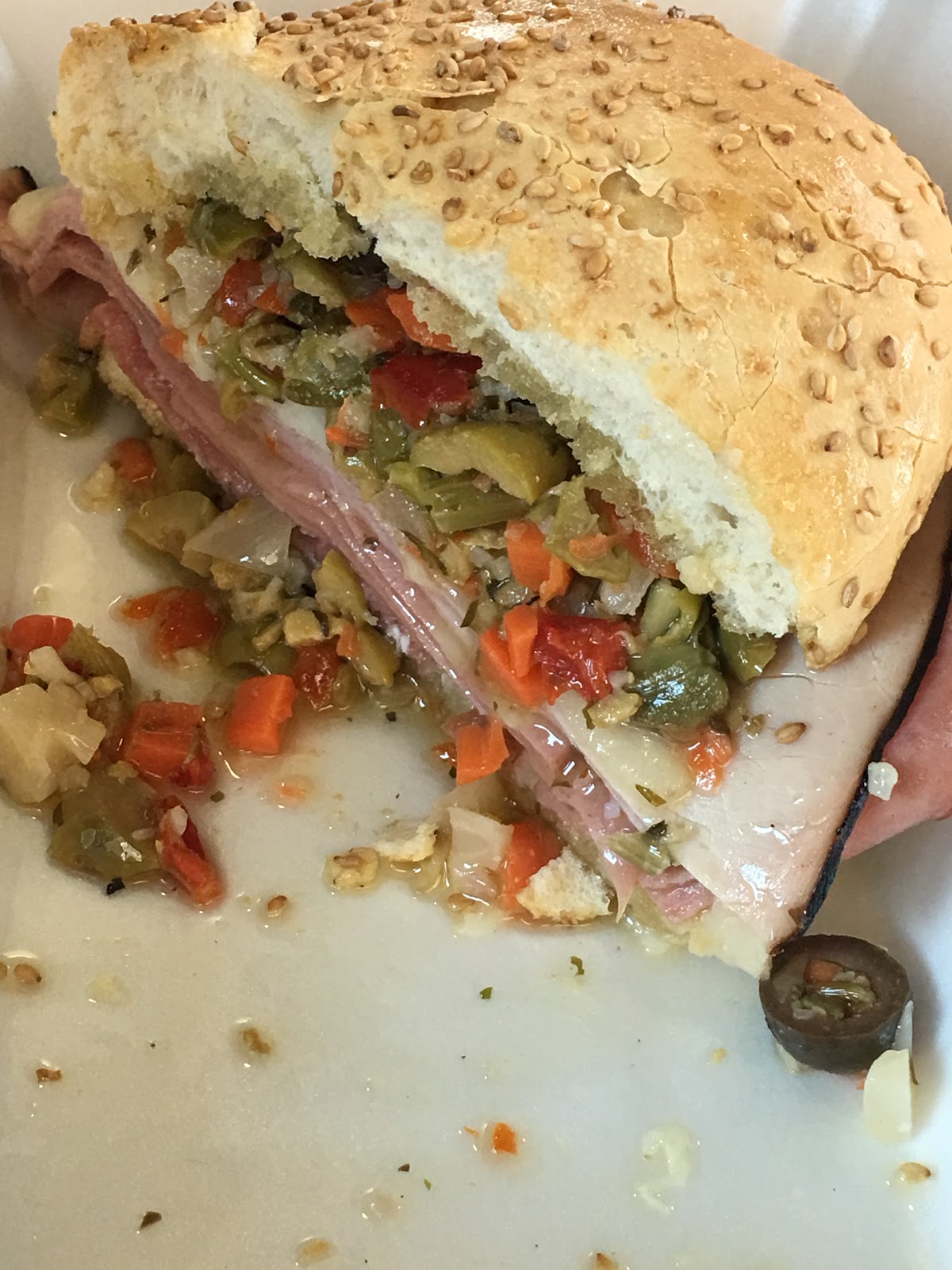 |
A small Muffaletta Sandwich -- olive salad with Italian cold cuts and cheese -- was $10 at Louis Armstrong New Orleans International Airport in Kenner, La.
|
 |
The Hyatt House on Poydras Street in downtown New Orleans "upgraded" us to a suite on the unlucky 13th floor. Sure enough, the room was cursed with a broken toilet, a shower that flooded the bathroom and other problems. We enjoyed the free breakfast with made-to-order omelets, but not the many dirty utensils, plates and bowls we saw during our entire stay, despite repeated complaints to the staff.
|
 |
At the airport, you'll thank your lucky stars when you get a boarding pass marked "TSA Pre" with a check mark next to it, as I did in both Newark and New Orleans. That means you'll be shown to a special security line, where you won't have to take off your shoes or remove your computer from its bag, and your body won't be groped or scanned. You'll be on your way in a matter of minutes.
|
Next: In North Jersey,
you have to read the labels,
even with seafood.


