Showing posts with label Consumer Reports. Show all posts

Monday, October 3, 2016

AARP The Magazine is last place seniors should go for nutrition advice

AARP The Magazine urges seniors to choose an Arby's roast turkey and bacon sandwich, right, over a roast beef and cheddar cheese sandwich, left, arguing the latter has fewer calories and less fat. Who in their right mind would eat either of them -- stuffed as they are with harmful antibiotics, preservatives and cholesterol?

Editor's note: AARP The Magazine and Consumer Reports cover food and nutrition in completely different ways. AARP's articles appear to be filled with marketing tie-ins and plugs for advertisers, while CR exposes restaurants supplied by factory farms that give massive amounts of harmful antibiotics to healthy animals.

By VICTOR E. SASSON
EDITOR

Do the senior citizens you know stick to a steady diet of fast-food and chain restaurants?

AARP, formerly the American Association of Retired Persons, thinks they do, judging from a major article in its magazine, "Eat This, Not That!"

"Forget fad diets and deprivation," the editors declare. "Instead, lose weight and get healthy with these simple food swaps."

Like ordering the Rib Eye and Baked Potato with Butter and Sour Cream at Ruby Tuesday over the Asiago Peppercorn Sirloin, Biscuit and Broccoli to avoid the latter's higher dose of sodium.

Or picking the Sugar Raised Doughnut and Iced Latte at Dunkin' Donuts over the Sesame Seed Bagel with Plain Cream Cheese to avoid 200 extra calories.

But all of those so-called healthier meals deliver big doses of unwanted sugar, cholesterol or saturated fat.

The editors at AARP The Magazine think the majority of Americans over 50 can't stick to a diet.

Instead, they urge readers to pick "slightly healthier versions" of pizza, ice cream, chocolate" and "other foods that you enjoy."

That's a formula for disaster.


CR gives 'F' to chains

Consumer Reports asks:

"Did you know that large factory farms that serve restaurants like KFC, Burger King and Dunkin' Donuts regularly give massive amounts of antibiotics to healthy farm animals?

"Instead of being reserved for treating sick people, antibiotics are used to fatten up cows and chickens and help them survive in factory farm conditions."

Restaurants that received an "F" rating on CR's report card include Domino's Pizza, Sonic, Starbuck's, Jack In The Box, Little Caesars, Chili's, Denny's, Arby's, Olive Garden, Applebee's, Buffalo Wild Wings and IHOP.

Doing slightly better ("D") are Pizza Hut and Papa John's. McDonald's, Wendy's and Taco Bell were graded "C"; Subway and Chick-fil-A got a "B."

The only "A" ratings went to Panera Bread and Chipotle Mexican Grill.

"The problem with factory farms overusing antibiotics is that they are creating resistant bacteria that spreads through our food, water and the environment," the magazine reports.

"Scientists have been telling us for years that antibiotic-resistant superbugs are multiplying at an alarming rate, and we know that medicines to treat deadly infections aren't working like they used to."

Common-sense advice

A second part of the AARP article is far more useful.

For example the editors recommend salmon, tuna, sardines, anchovies and other fish for their beneficial omega-3s -- which can lower the risk of type 2 diabetes -- compared to the very few omega 3s in tilapia and catfish.

Other recommendations include olive oil over soybean oil, and reduced-sodium soy sauce over regular soy sauce.


In the April/May 2016 issue of AARP The Magazine, only fast food and chain restaurants -- which are supplied by factory farms -- are listed, including Chick-fil-A, Outback Steakhouse and P.F. Chang's.

The editors' picks are called "slightly healthier versions."

Tuesday, April 7, 2015

Picking up more Costco Wholesale organics, H Mart sale items

My Costco Wholesale in Hackensack carries two canned salmons -- wild Alaskan sold under the Bear & Wolf name from Trident Seafoods Corp., above, and Kirkland Signature Atlantic Salmon, an artificially colored farmed product from Chile, below. Trident says its salmon is not processed in China.

The farmed salmon comes in 7-ounce cans. The wild pink salmon is in 6-ounce cans. The farmed product is $14.99, compared to $12.99 for the wild fish.

Editor's note: Today, I discuss the pricing of organic food at Costco Wholesale, and whether a canned Alaskan salmon sold in the warehouse store is processed in China.

By VICTOR E. SASSON
EDITOR

At Costco Wholesale in Hackensack today, I picked up organic extra-virgin olive oil for about $1.50 less per quart than the best buy at eight supermarkets shopped by Consumer Reports.

Kirkland Signature Organic Extra Virgin Olive Oil, a blend from Greece, Italy, Spain and two other countries that is delicious on salads, was $15.99 for 2 liters (2 quarts and 3.6 ounces).

In the May 2015 issue, Consumer Reports found the cheapest organic extra-virgin olive oil at a southern chain, Harris Teeter, for $9.01 a quart, compared to $7.57 per quart for the Costco EVOO.

Three half-gallons of Kirkland Signature Organic 1% Milk were $9.99 or $3.33 each, compared to $3.49 a half-gallon for organic milk at Safeway, the lowest price  the magazine's shoppers found.

I also picked up Coleman Organic Chicken Drumsticks for $1.99 a pound, and 1-pound of Earthbound Farm Organic Spring Mix for $4.99.

Among non-organic items, I bought six 6-ounce cans of Bear & Wolf Pink Salmon, a wild fish from Alaska, for $12.99.

A 3-pound bag of U.S. No. 1 sodium-free raw Almonds, which I roast at home, was $16.89, a hike of nearly $1.


The Kirkland Signature farmed salmon is artificially colored. 


Processed in China?

This blog occasionally receives comments from readers who have "heard" that food sold in the United States was raised or processed in China, which has a terrible food-safety record. 

I just got this anonymous comment:
"I wonder if you've heard that Trident salmon in cans is processed in China? I just found the product in our new Costco and was totally disappointed at fish processing being done in factories overseas. Thank you."
The apparent reference is to the canned Bear & Wolf Premium Skinless and Boneless Pink Salmon, which is labeled as "Product of USA," that I purchased today at Costco.

The canned salmon is from Trident Seafoods Corp., which is based in Seattle, Wash.

But there is no evidence in the comment, besides what the person "heard."

I sent an email to the company's Consumer Affairs Department, and got this reply from a woman named Trev Foley:
Some, but not all, of our items do have initial processing done overseas, with final processing done in Washington State. Our canned salmon items, such as the Bear & Wolf Pink Salmon, do not have overseas processing. The salmon are harvested in the Pacific Ocean (Gulf of Alaska, Bering Sea, etc.) and canned in Alaska, within 24 hours of being caught. Please be assured, we maintain strict oversight of all of the fish we sell, from start to finish. For those items which have partial processing done overseas, the fish are processed in contracted facilities where we have on-site Trident Seafoods operations and quality assurance personnel insuring the safety of the food. Additionally, the facilities we use are inspected and certified to the Global Food Safety Initiative (GFSI).
 In 2012, I opened a can of this same pink salmon from Costco, only to find mold on it. See:
Mold in Bear & Wolf canned salmon from Trident?


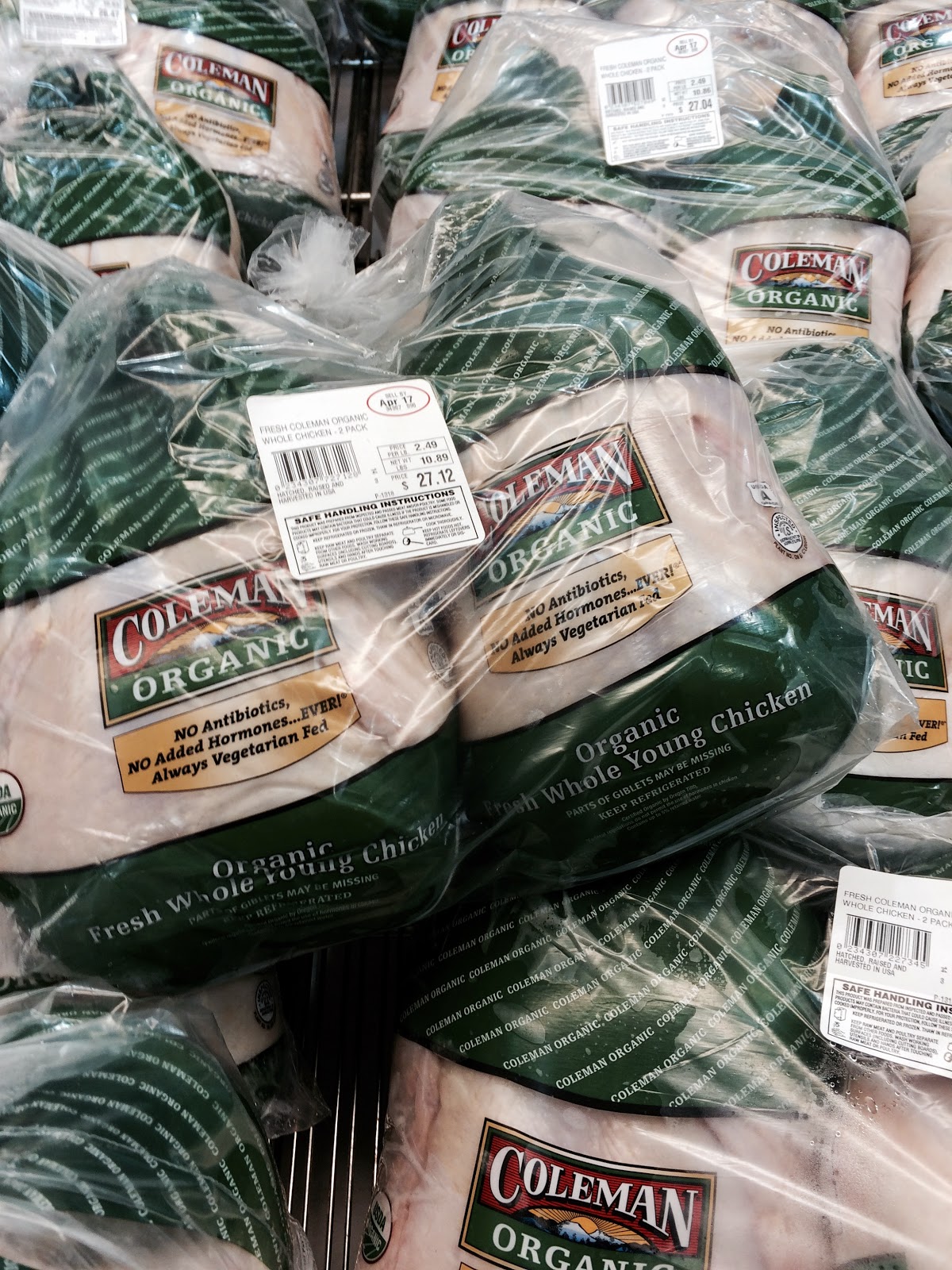
Coleman Organic Fresh Whole Young Chicken at Costco Wholesale in Hackensack was $2.49 a pound, meeting the lowest price for whole or cut up organic chicken at the Safeway chain in the Consumer Reports survey.

Basmati rice contains less arsenic than other kinds of rice, according to Consumer Reports. Costco Wholesale in Hackensack sells Deer-brand from "the foothills of the Himalayas" (India).

These are the shipping boxes for the low-quality but wildly popular 3-pound Kirkland Signature Rotisserie Chicken sold for $4.99 at Costco. I could not make out the name of a producer or processor on the labels of the boxes, which were behind glass in the butcher department of the Hackensack warehouse store.

At H Mart in Englewood on Sunday, half-gallons of lactose-free milk were on sale for $1.99 or $2 off through April 13, the lowest price I've ever seen for this type of milk.

The Englewood H Mart also carries Earthbound Farm Organic Celery and Organic Carrots. Olivia's Organic Spring Mix in a 5-ounce tub was on sale for $2 or $1 off when you bought two.

At the Englewood H Mart, this package of kimbap, an addictive seaweed-and-rice roll, was labeled as weighing 1 pound, but on my kitchen scale, it weighed more than 29 ounces or nearly 2 pounds. The imitation crab is made from a fish called pollock. The roll comes with pickled radish and jalapeno peppers.
On Good Friday, whole wild-caught black sea bass were $5.99 a pound at the Englewood H Mart.

A large wild whole red snapper, which my wife poached in coconut milk, was $7.99 a pound at the Korean supermarket, 25 Lafayette Ave., Englewood (201-871-8822).


Wednesday, February 18, 2015

Cheap wine at Stew Leonard, naturally raised bacon at Trader Joe's

You'll have to run the gauntlet of more expensive bottles to find drinkable reds for under $5 at Stew Leonard's Wines in Paramus, above and below.


By VICTOR E. SASSON
EDITOR

If you are only interested in bottles of drinkable red wine for around $5 each, Stew Leonard's Wines in Paramus will make you work for them.

On Monday, I walked past hundreds of more expensive bottles before I found what I was looking for in the farthest corner of the store -- on a bottom shelf.

The bottles of Pinot Noir, Cabernet Sauvignon and Merlot from Chile carry the Los Caballos label ($4.99 each).

I also found 1.5-liter sizes (equal to two bottles) of Sangiovese and Montepulciano d'Abruzzo from Italy for $9.99 and $8.99, respectively.

Whole Foods Market in Paramus and any Trader Joe's with a liquor department have a wider selection of inexpensive wines.

The Stew Leonard's Wines Web site says the stores are independently owned and operated, not part of a cooperative buying group and not part of Stew Leonard's food chain. 

Stew Leonard's Wines, 396 Route 17 north, Paramus; 201-649-0882. 

Web site: Stew Leonard's Wines 


Trader Joe's in Paramus is offering an organic version of Costco Wholesale's Kirkland Signature Natural Peanut Butter, made only with Valencia Peanuts and sea salt. A 16-ounce jar of Trader Joe's Organic Peanut Butter is $3.49, compared to $10.99 for two 40-ounce jars of Costco's Natural Peanut Butter, which should be stored in the refrigerator to prevent separation.


Trader Joe's and antibiotics

Trader Joe's won't say "no" to antibiotics.

The specialty grocery store still hasn't heeded the call of Consumers Union -- the policy and advocacy arm of Consumer Reports -- to stop selling meat and poultry from animals raised on human antibiotics, as any visit to the Paramus store shows.

On Monday, I drove out of the Stew Leonard's Wines parking lot and into the Trader Joe's lot next door to shop for the meat eaters in the family.

I found antibiotic-free Trader Joe's Uncured All Beef Hot Dogs, but Trader Joe's Jumbo Uncured Beef Franks contain meat raised on antibiotics (16 ounces, $4.99 each).

W brand Uncured Bacon is all natural pork raised without antibiotics ($5.49 for 12 ounces).

However, Trader Joe's Uncured Apple Smoked Bacon is pork that received antibiotics and possibly growth hormones ($4.99 for 12 ounces).

Consumers Union believes "the overuse of antibiotics by the meat and poultry industries on healthy animals is promoting the spread of drug-resistant super bugs that threaten public health."

Trader Joe's, 404 Route 17 north, Paramus; 201-265-9624. Open 8 a.m. to 10 p.m. daily.


Sunday, February 1, 2015

Fat chickens raised for Perdue spend brief lives sitting in feces


Editor's note: Two magazine articles caught my eye, one from Consumer Reports on whether Perdue chickens are raised humanely, and the other from AARP The Magazine, which recommends seniors gorge on ham, cheese, fried eggs and beef meatballs on vacation in Holland.


By VICTOR E. SASSON
EDITOR

One of the most shocking images in a YouTube farm video are overweight chickens that have grown too big to stand and spend much of their brief lives sitting in feces, rubbing themselves raw in some cases.

The March 2015 issue of Consumer Reports says Craig Watts, a chicken farmer in Fairmount, N.C., objected to Perdue's claims of humane treatment, and invited an animal welfare group to film inside his chicken house.

"Watts is familiar with the standards of the country's fourth-largest chicken producer," the magazine reports. "He raises about 720,000 birds for it each year in facilities approved by Perdue and the USDA Processing Verified program.

"The result is a video that shows what appear to be thousands of birds crammed in the dark, gasping for air and weighed down by unnaturally large breasts [from the antibiotics administered to the chicks supplied by Perdue, this after only 37 days]."

The litter they sit in, according to the video, contains the accumulated feces of tens of thousands of chickens, and isn't changed between flocks.

The video went live on Dec. 3, and has reached more than 1.5 million viewers.


Eating your way to poor health


The December 2014/January 2015 issue of AARP The Magazine has an upbeat feature on a young couple who produce EatYourWorld.com, a guide to eating around the world.

But the Dutch food the couple sample in Amsterdam is filled with the calories and artery clogging cholesterol many of the seniors who read the magazine are trying mightily to avoid.

They might want to rename their Web site, Eat Your Way Into a Hospital.

First, Laura Siciliano-Rosen and photographer Scott B. Rosen recommend a cure for jet lag: A "massive open-face ham, cheese and fried-egg sandwich."   

Then, they suggest a Gouda cheese sandwich on crusty bread "slathered in butter."

They finally sample some healthy herring, but then finish with "gravy-doused beef meatballs."

The headline for the article on Page 68 is "Our Dutch Treat."

It could be, "Trick or Treat."

I can't imagine what the editors were thinking when they picked this article for AARP The Magazine.

Certainly, not the health of their aging readers.

Thursday, February 6, 2014

Snowy Atlantic cod all the way from Iceland, arsenic in food and more

Cod two ways. Fresh, wild-caught Atlantic cod coated in a homemade Super Spice Mixture paired with organic whole wheat shells and salted cod in marinara sauce.

Editor's note: Atlantic cod  fed the world for hundreds of years before the wild catch was severely restricted. Now, this wonderful fish is being long-line caught in Iceland, and sold at Costco Wholesale for only $7.99 a pound, along with salted cod from Canada. Today, I also discuss arsenic in food.

By VICTOR E. SASSON
EDITOR

You have to love Atlantic cod, a wild-caught fish that turns snowy white when cooked and flakes beautifully.

This is the fish that fed the world for centuries. The U.S. commercial catch collapsed in the mid-1990s.

Now, Costco Wholesale in Hackensack is selling Atlantic cod from Iceland ($7.99 a pound), where it is long-line caught by a sustainable fishery, replacing the Pacific true cod I've been buying for a couple of years.

Costco also offers 2 pounds of Cristobal-brand salted cod fillets from Canada for $11.99 -- less than $6 a pound.


My two-cod dinner ended with a salad of Earthbound Farm Organic Spring Mix with ripe pear and shavings of Parmigiano Reggiano Cheese.
Salted cod with cabbage and collaloo, which is similar to spinach, served with mashed sweet potatoes with extra-virgin olive oil, a little salt and a touch of cinnamon.
Fresh cod fillets are meaty and break into big flakes.

Every spice you have

I squeezed fresh lime juice on the cod fillets, coated them with a Super Spice Mixture and baked them at 375 degrees for 30 minutes.

For the spice mixture, I start with Wick Fowler's 2 Alarm Chili Kit, and add every spice and dried herb I have at home, including chili powder, garam masala, garlic powder, five-spice powder, dried onion and black pepper.

I make a big tub of the spice mixture and keep it in the refrigerator to coat fish, chicken, beef and pork.


Shavings of Parmigiano Reggiano add flavor and texture to organic brown eggs from Costco, served here with leftover organic brown rice, one of my favorite bread substitutes at breakfast.

Say cheese

Costco Wholesale still has the best price in North Jersey for wedges of Parmigiano Reggiano, the hard, reduced-fat cheese that is one of Italy's great culinary gifts to the world.

Costco's Kirkland Signature cheese, aged 2 years, is $11.79 a pound. Costco also sells this cheese shredded.

We recently purchased a 10-pound bag of sweet potatoes at Costco for $7.99 a pound, but came across an old receipt that showed the same 10 pounds cost only $4.99 before Christmas.

On Monday, I picked up three 32-ounce bottles of
Classico Traditional Tomato & Basil pasta sauce for $6.79 or about $2.26 each, but these bottles hold about 6 ounces more than those sold in supermarkets.


Kirkland Signature Marinara was $7.99 for three 32-ounce bottles. Neither brand has added sugar.

I also picked up another 12-pack package of Kirkland Signature Roasted Seasoned Seaweed from South Korea for $7.89.

Each of the packages, larger than what is sold at Korean supermarkets, weighs six-tenths of an ounce. 

The thin, crinkly sheets can be eaten out of the package for a snack or used to wrap rice, barbecued beef or raw fish.


Organic whole wheat shells from Whole Foods Market with salted cod and fresh chopped garlic in bottled marinara sauce with added extra-virgin olive oil, red-pepper flakes and dried herbs.

Another great fish sold at Costco Wholesale is Alaskan sockeye salmon -- smoked and sliced -- used here in a frittata with cheese, sun-dried tomato and Kirkland Signature Basil Pesto, above and below.


Arsenic in food


The March 2014 issue of Consumer Reports says the Food and Drug Administration "has found arsenic levels in rice and rice products comparable to those" found by the magazine in its own investigation.

The FDA also found "another surprising source of arsenic: beer, which sometimes uses rice as an ingredient," the magazine states.

Arsenic is found in white rice and apple juice, as well as beer and rice beverages.

The magazine said medium-grain rice from California tended to have lower levels of inorganic arsenic than rice originating from other areas of the United States.

"One way arsenic might enter the food supply is through the use of arsenic-based drugs in feed given to chicken, turkeys and pigs to prevent disease and promote growth.

"Poultry droppings are used to fertilize many crops and can contaminate them with arsenic. And chickens that are likely raised with arsenic-based drugs result in chicken parts that can have higher inorganic arsenic than other chickens," the magazine reports, citing a 2013 study by the John Hopkins Center for a Livable Future. 

Update


Here is a link to the only arsenic food certification agency:

http://arsenicsafe.org/


Monday, July 15, 2013

Hot food topics: Fecal bacteria, GMO and mercury

Consumer Reports came up with disturbing findings when it tested samples of ground turkey bought at retail stores nationwide.


By Victor E. Sasson
Editor

Lean ground turkey sounds like a healthier alternative to ground beef, but consumers may be  getting more than just poultry, according to Consumer Reports.

"In our first-ever lab analysis of ground turkey, more than half of the packages of raw ground meat and patties tested positive for fecal bacteria," the June 2013 issue reports.

The bacteria found most often were Enterococcus  and Escherichia coli or E. coli.

"Ground turkey labeled 'no antibiotics,' 'organic' or 'raised without antibiotics' was as likely to harbor bacteria as products without those claims," the magazine said. 

"(After all, even meat from organic birds can pick up bacteria during slaughter and processing.)

"The good news," according to the magazine, "is that bacteria on these products were much less likely to be antibiotic-resistant superbugs."

In 2011, the Food and Drug Administration found even higher rates of contamination than Consumer Reports, the magazine said.

Non-GMO feed

Organic turkeys and chickens do have one clear advantage from a consumer standpoint:

"Organic birds must eat only certified organic feed and pasture, which means no genetically modified organisms" (GMO), the magazine said. 


One of the ingredients in my canned fish salad with chickpeas is Genova-brand Premium Yellowfin Tuna, marked "Solid White Tuna" on 7-ounce cans from Costco Wholesale.
   

Mercury in tuna

I enjoyed a beautiful loin of rare yellowfin tuna the other night at Bel Posto, the fine-dining restaurant on Prospect Avenue in Hackensack.

But the next day, I did some research out of my concern over mercury in tuna, which I usually try to avoid when eating sushi.

Yellowfin, it turns out, are smaller than other types of tuna, according to research at Rutgers University I saw on the Web site of the American Museum of Natural History:

"Research at Rutgers University on the mercury content of tuna served in restaurants and sold in supermarkets shows surprisingly that tuna sushi purchased in supermarkets might be healthier than that from restaurants. 

"Sushi samples for this research project were taken from 54 restaurants and 15 supermarkets in New York, New Jersey, and Colorado. 

"The sushi made for supermarkets tends to be yellowfin tuna.

"Although yellowfin tuna is very lean, this species tends to have lower accumulation of mercury, likely because yellowfin are typically smaller than other tuna and are harvested at a younger age. 

"Furthermore, yellowfin are tropical and do not 'thermoregulate' like the warm-blooded bigeye tuna and bluefin tuna. 

"Because bigeye and bluefin species eat three times more than yellowfin to maintain their energy level, they might bioaccumulate, or slowly increase the level of toxins over time."

Tuesday, November 20, 2012

Why all of us are confused about nutrition

This idealized farm house on the side of Perdue chicken trucks is part of a campaign by that processor and many other companies to trick the public into thinking they are buying food that has been raised or grown naturally on small family farms.


I received a comment from a reader, Emily Wesley, who said:


"You have written a nice blog, and I have learned a lot from you after reading this. 

"Still, you can add some more information about these organic foods sold in markets by discussing their benefits. 

"I am a concerned person on what I eat and in everything I do."


It's no surprise that, like many of us, Emily wants more information about the nutritional value of organic and other food.

I don't hold myself out as an expert, but I do know where she and others can go for unbiased information about food.

It's not the mainstream media, which depend so heavily on advertising from food processors, supermarkets and restaurants.

Forget the papers

It certainly isn't my local daily newspaper, which employs a restaurant reviewer who is so addicted to sugar she occasionally rates the desserts higher than the entrees, and rarely eats salad.

And don't bother with the Food Channel, which is also beholden to advertisers.

Recall recent news reports on a study that supposedly exposed the "empty calories" in alcoholic drinks and compared them unfavorably with such sugary drinks as Coke and Pepsi.  

Red wine may have "few nutrients," but it has proven health benefits, doesn't rot your teeth and isn't linked to the obesity epidemic, as sugary drinks are.

So, does the issue of "empty calories" really matter or is this just another clueless wire-service reporter trying to hype the latest study?


Winking at Twinkies


After Hostess, the company that makes some of the worst processed food known to man, looked like it was going out of business, National Public Radio actually called Twinkies and Ding Dongs "iconic foods."

I feel bad for all the workers who might be joining the unemployment lines.

But if Twinkies can by any stretch of the imagination be called "iconic," then they are another symbol of the obesity epidemic and all that is wrong with the marketing of junk food.  

In fact, "Ding Dong" sounds like a character in a porn movie.


What you could look like, if you eat Twinkies and other junk food.


Road to ruin 

On the New Jersey Turnpike, travelers pay for the privilege of stopping for fried chicken, low-quality fast-food hamburgers and other unhealthy food.

They fill the tables in the food courts of rest areas, gorging on greasy french fries and ignoring the few healthy choices, such as salads at an Italian-American concession or the fruit-and-cheese plate at Starbucks.

Watching them eat is almost enough to turn my stomach.

On Monday, I stopped for a cup of coffee on the turnpike, and noticed that the Asian Indian man at the next table was eating a salad he had brought with him.

He said he runs the sunglass concession, and always brings his own lunch. As a Hindu, he doesn't eat meat.

And if he did, he certainly wouldn't be eating any of the garbage served at Nathan's or Burger King.

Cholesterol, he said, clogs coronary arteries and weakens vision.


Most of the food choices on the New Jersey Turnpike are unhealthy.
  

Honest food reporting 

If you want honest, unbiased reporting on food, nutrition, supermarkets and related issues, Consumer Reports is one of the few places to find it.

Consumer Reports magazine and a newsletter, Consumer Reports on Health, are filled with information you will have a hard time finding anywhere else.

They are published by the non-profit Consumers Union, and they don't accept advertising.

Consumers Union recently launched a campaign to get a big food retailer, Trader Joe's, to carry only antibiotic-free meat and poultry.

Have you seen anything on the campaign in the mainstream media? Of course not.  


Jumbo shrimp and mixed vegetables in fresh garlic from Zen Kitchen in Teaneck.

Leftover vegetables made a great side dish at breakfast the next day.


Personal tips

You can go a long way toward improving your health by giving up meat and poultry altogether.

Eat as much fruit and vegetables as possible, even non-organic; choose the kind of whole grains you find in brown rice and whole-wheat pasta; buy wild-caught, low-mercury fish, and low-fat milk and cheese; and favor ethnic restaurants that serve tofu and lots of vegetables.

I gave up bread, pizza, meat and poultry, and lost more than 40 pounds. I go to the gym, and walk as much as possible. 

And I have a glass of red wine with dinner two or three nights a week.

I feel great, and look forward to every meal.