Showing posts with label Consumer Reports magazine. Show all posts

Saturday, July 11, 2020

For my family's safety, we've switched to glass food-storage containers

BAD NEWS: The June 2020 issue of Consumer Reports magazine warns readers they may be consuming as much as a credit card's worth of plastic a week.


By VICTOR E. SASSON
EDITOR

HACKENSACK, N.J. -- We're trying to eliminate the use of plastic in our kitchen -- from food-storage containers to our coffee maker to utensils and cups we'd use when cooking on our barbecue and eating on the deck.

Besides buying glass containers to replace our many plastic food-storage containers, I stopped using our cheap, mostly plastic Mr. Coffee coffee maker and started brewing coffee in a stainless steel Farberware Superfast percolator my mother used in the 1980s and 1990s.

Read my full report on the dangers of microplastic in our food and water, and what you can do to lessen the health risks:


Tuesday, January 26, 2016

Consumer Reports: How dangerous bacteria travel from farm to table

This easy to understand graphic appears in the January 2016 issue of Consumer Reports, a magazine that has taken the lead on trying "to stop the antibiotic overuse in meat and poultry production that gives rise to dangerous bacteria."


By VICTOR E. SASSON
EDITOR

You could say the story of how dangerous bacteria gets from the factory farm to your table is full of shit -- or manure, if you prefer a more polite word.

The story begins on farms where healthy animals "are routinely given antibiotics in their food and/or water," and "bacteria that's present in the animals' intestine react with the antibiotics," Consumer Reports says.

"Some of the bacteria are killed, but a few survive. Those resistant bacteria flourish."

In the final part of a three-part series, the magazine traces bacteria that are resistant to antibiotics as animals excrete it in manure, and how the bacteria can be spread to the community.


Many carriers

In the January 2016 issue, the magazine's editors note resistant bacteria or superbugs spread:

"Via soil, when animal waste is used to fertilize crops; via water, when waste seeps into groundwater; and via air, when bacteria are carried by the wind."

Also, "via farmworkers, who pick up the bacteria on their skin and transfer it when they come into contact with other people; and via flies, which carry bacteria they have picked up on the farm."


During slaughter

Even scarier, "resistant bacteria can also contaminate raw meat during slaughter or processing" in a number of ways.

"Plant workers can pick up bacteria on their skin and transfer it to the meat or to other people," and "raw meat sold in supermarkets may contain bacteria that may infect people who handle or eat it."

The bottom line is that people become ill with antibiotic-resistant infections, and some die.


See: The Rise of Superbugs


Factory farms

Nowhere are antibiotics "more inappropriately employed than in the meat and poultry industries," according to Consumer Reports.

"Abut 80 percent  of the antibiotics sold in the U.S. are give to animals raised for food -- including hogs, cattle, chickens and turkeys.

"The most recent data from the Food and Drug Administration show that more 32 million pounds of antibiotics were sold for use food animals in the U.S. in 2013 -- up 17 percent from just four years earlier."

About 20 percent of people sickened by an antibiotic-resistant bug don't pick it up in the hospital or from another person -- they get it from food."


Best practices

The article contains two lists showing which chain restaurants, and meat and poultry producers use human and animal antibiotics, and which don't.

I was surprised to learn that Coleman Natural and Niman Ranch, two brands known for organic or naturally raised meat and poultry, are owned by Perdue, which uses antibiotics widely.

The only chains that ban antibiotics for growth promotion and disease prevention, as well as other drugs, are Chipotle Mexican Grill and Panera Bread (beef, chicken, pork and roasted turkey).

What you can do

I've stopped eating meat and poultry altogether, but other family members look for organic or antibiotic-free beef, chicken and turkey.

When I buy seafood, I look for wild-caught fish and shrimp or farmed fillets that are raised without antibiotics. 


Wednesday, November 25, 2015

Cows eat chicken-coop waste, candy, plastic pellets -- so why eat them?

Cows destined to become steaks and hamburgers are confined to a feedlot and given antibiotics, hormones and other drugs to promote fast growth and prevent disease.


By VICTOR E. SASSON
EDITOR

Consumer Reports magazine has published a shocker on what conventionally raised cows eat, and how the beef from them is more likely to contain harmful bacteria.

"If you don't know how the ground beef you eat was raised, you may be putting yourself at higher risk of illness from dangerous bacteria," according to the editors of the expose, "How Safe Is Your Beef?"

"You okay with that?"

What they eat

In a side-by-side comparison called "A Tale of Two Cows," the magazine describes where conventional and grass-fed cattle live, their diets, drugs administered and how they are slaughtered.

The real eye-opener is the diet for conventional cattle, which are raised on pasture "for the first year or so" before they are confined to a feedlot.

"In the feedlot, corn and soy are the primary foods, but the cows may also be fed candy, chicken coop waste, and the slaughterhouse remains of pigs and chickens," the magazine reports.

"They may also be given plastic pellets, which are used as a substitute for the fiber they'd normally get from grazing on grass.

"Antibiotics, hormones and other drugs can be given to the cattle to promote growth and prevent disease.

"Large meat-processing plants slaughter as many as 400 head of cattle in an hour. Inhumane rapid processing may increase the chances of bacteria contaminating the beef."
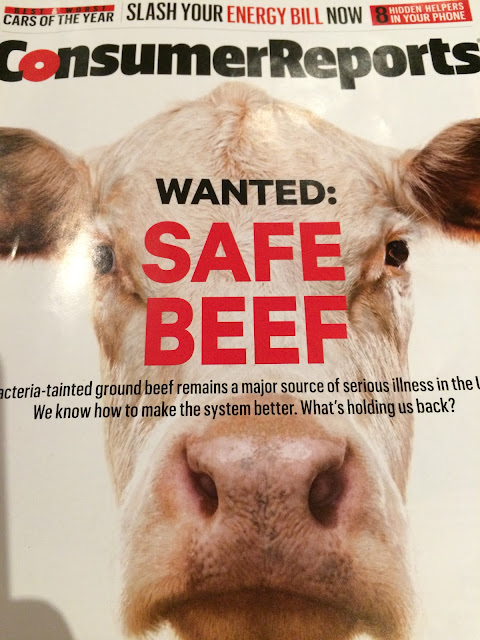

The cover of the October 2015 issue of Consumer Reports, the nation's leading publication on food safety.

Grass-fed advantage

When cows are grass fed, they "spend their entire lives grazing on grassland."

"Thus, these animals are not subjected to the crowded, disease promoting conditions of feedlots."

"Though grass-fed animals may be given antibiotics, their living conditions and diet generally make the need for them much less likely.

"Organic grass-fed cattle can't be given antibiotics or hormones," the magazine says.

"Grass-feed farms generally take their animals to smaller regional plants, where slaughter practices may be more humane."

How to cook ground beef

The magazine purchased 300 packages of ground beef from 103 grocery, big-box and natural food stores in 26 cities across the country -- both conventional and from cows raised in more sustainable ways.

"The results were sobering. All 458 pounds of beef we examined contained bacteria that signified fecal contamination, which can cause blood and urinary tract infections."

But "one of the most significant findings of our research is that beef from conventionally raised cows was more likely to have bacteria overall, as well as bacteria resistant to antibiotics, than beef from sustainably raised cows."

The magazine says if you are going to eat hamburgers and other ground beef, make sure you cook them "to at least medium," which is 160 degrees Farenheit.

"Eating a burger that's rarer can be risky."


Friday, May 22, 2015

Sweet potatoes and pesticides, complaints about Clayton's beef

Natural sugar oozing from organic sweet potatoes I baked at home.


By VICTOR E. SASSON
EDITOR

In the May 2015 issue of Consumer Reports, you can find a chart showing the risk of pesticide exposure from eating 48 fresh conventional fruits and vegetables from 14 different countries.

"We recommend buying organic for any produce-country combination in the medium or higher risk categories," the editors say.

"We found that all organic produce falls into the low- or very low-risk categories," the magazine reports.

Still, a footnote says, "Our analysis is based on the risk to a 3-and-a-half-year-old child, estimated to weigh 35.2 pounds."

Sweet potatoes -- one of the key bread substitutes I rely on to maintain my weight loss -- are listed in the high-risk category, and the magazine says:

"Beware of conventional," if the sweet potatoes are from the United States.

But I will continue to buy conventional and occasionally organic sweet potatoes, because Consumer Reports and other experts say their N0. 1 rule is to eat more produce.

"Getting plenty of fruits and vegetables -- even if you can't obtain organic -- takes precedence when it comes to your health," the magazine states.

Consumer Reports leads all general-interest publications, including newspapers, in reporting on pesticide use, antibiotics in meat and poultry, and other important food issues.


A 3-pound bag of organic sweet potatoes, top, at the ShopRite in Paramus goes on sale occasionally for $4.99. On Tuesday, I bought a bag at the regular price of $5.99, but it tipped the scale at nearly 4 pounds, below.

A 3-pound bag of conventional sweet potatoes at ShopRite is $2.99, but often weighs 3.5 pounds or more. Trader Joe's on Route 17 in Paramus sells organic and conventional sweet potatoes at lower prices than ShopRite.
A 3-pound bag of Southern's 10 in 1 Sweet Potatoes is a favorite purchase at the Paramus ShopRite. Even though these are conventionally grown, they are triple washed, which would reduce our exposure to any pesticide residue.

A large, seedless watermelon from Florida was $6.99 at the Paramus ShopRite, a discount of $1. No need to thump. Pick the biggest and heaviest you can find.


Clayton's Organic Ground Beef from Australia in the refrigerated case of the ShopRite, 224 Route 4 east, Paramus.


Clayton's Organic Beef

Here is a comment I received in February from a reader who buys Clayton's Organic Ground Beef from Australia at the ShopRite, at 668 Route 70, Brick, a town on the Jersey shore:

"I've been buying Clayton ground beef at Shop-Rite for several years now, at least one-pack per week and we love it. It's the best ground beef I've have ever had. 
"But, the past 2 months I've noticed the Clayton ground beef is not as lean as usual and I don't blame Clayton.
"Upon closer inspection I've noticed that it appears that Shop-Rite (Bricktown - Rt 70) is re-packing the date-stamped vacuum-sealed Clayton ground meat and adding filler if the meat is near the expiration date. I think maybe they are adding fresh ground beef of low quality. 
"All I know is that it looks like the packages are being tampered with and resealed by the Butcher Dept., at least at this particular Shop-Rite."

Then, on May 18, another reader said:
"I read the above post and agree the Clayton ground beef at the RT 70 Brick Town Shop-Rite does not taste the same as the the Clayton ground beef purchased at other Shop-Rite stores.
"Their steaks taste the same, they are consistent and don't vary from store to store, but imo [in my opinion], not the ground beef.
"Doesn't taste as fresh and doesn't have the WOW factor even though the expiration date is almost one month out.
"IMO, something's not right. 
"Maybe a SR Representative could investigate by comparing the ground beef from several different stores (visually inspect and compare & cook and taste test it) and see for themselves without informing the meat dept management or employees."

I called Wakefern Food Corp., a cooperative composed of 50 member companies that own and operate supermarkets under the ShopRite banner. 

A ShopRite spokeswoman said:
"All Clayton's Organic Beef is vacuum sealed - and is not resealable - to ensure freshness and to protect the integrity of the product. We take these complaints very seriously and would ask any customer who feels that they have purchased a product that does not meet their expectations to let us know via our Customer Care Center at 1-800-ShopRite. 
She also addressed the "distinctly different" taste of Clayton's Organic Ground Beef, compared to other beef, noting that Australian cattle are free range, grass fed and grain finished.

Depending on the time of year and "growth cycle of the grass," the taste of the beef can differ, she said.


If you buy three packages of Clayton's Organic Ground Beef at the Paramus ShopRite this week, you'll save $1.


Saturday, April 4, 2015

In Consumer Reports survey, Costco prices for organics are best

Organic eggs from Costco Wholesale in Hackensack, served here with organic quinoa prepared in an electric rice cooker, are $6.99 for two dozen, cheaper than at other supermarkets shopped by Consumer Reports.

A hearty breakfast: A Costco organic egg with leftover Whole Foods Market organic whole-wheat shells, prepared in vodka sauce with added red wine, sardines and anchovies.


By VICTOR E. SASSON
EDITOR

Consumer Reports shopped at eight grocers for organics -- including bananas, extra-virgin olive oil, milk and eggs -- but didn't price those items at Costco Wholesale.

In a May 2015 cover story, "The Best Supermarkets in America," some of those organic foods are cheaper at Costco than at Price Chopper, Walmart, Whole Foods Market, Fresh Direct or the other stores listed by the magazine.

At $3.99, a dozen organic large brown eggs were cheapest at Whole Foods Market, but Costco sells 24 for $6.99 or $3.50 a dozen.

None of the stores listed by Consumer Reports could match Costco's price for organic bananas, $1.99 for three pounds or about 66 cents a pound.

A half-gallon of organic milk is $3.66 at Costco when you buy three, compared to $3.49 at Safeway (no stores in New Jersey), and $3.58 at Amazon Fresh.

Though I haven't purchased organic quinoa, whole organic chickens or organic extra-virgin olive oil recently at my Hackensack Costco, I believe those items also are cheaper than at the stores listed in the magazine.

Earthbound Farm Organic Spring Mix is $4.79 to $4.99 a pound at Costco, and Organic Carrots are $6.99 for a 10-pound bag or 69 cents a pound.

Consumer Reports didn't compare organic spring mix prices, and the cheapest organic baby carrots listed were $1.69 a pound at Harris Tweeter (none in New Jersey).


I prepared organic quinoa with chopped fresh garlic, organic diced tomatoes and organic extra-virgin olive oil, all from Costco Wholesale, in an electric rice cooker and served it for breakfast with a Jamaican specialty, ackee and salt fish.

A baked sweet potato with  Mateo's Gourmet Salsa from Costco Wholesale, along with roasted sweet peppers and organic carrots, also from Costco, go great with ackee and salt fish.

A 5-pound box of sweet potatoes -- a great bread substitute -- was on sale for $2.99 on Tuesday at ShopRite in Englewoood. I boiled them with whole California garlic cloves from Costco Wholesale and mashed them with extra-virgin olive oil, salt and other seasonings, including cinnamon and curry powder.


Saturday, April 5, 2014

One stop for Korean haircut, manicure and noodles

At Closter Commons shopping center, Korean merchants offer good grooming, good food and more.

Editor's note: Today, I discuss Closter, a small town with a large number of Korean businesses; 100% grass-fed, antibiotic-free lamb at ShopRite; and how Costco Wholesale's prices are said to be lower than Walmart's.

By VICTOR E. SASSON
EDITOR

You could be in Palisade Park's Koreatown, where restaurants, nail and hair salons, and cafes are within steps of each other.

But the Korean merchants in Closter Commons are actually about a half-mile away from other Korean businesses in downtown Closter.

And they compete with merchants in an adjoining shopping center that has been renamed Closter Marketplace and, after several years of controversy, is getting a Whole Foods Market.

Trim and vacuum

This morning, I had my hair cut for $20 at Dong Yang Barber Shop, where the barber, Mr. Park, literally vacuumed and massaged my head to pick up stray hairs.


He had cut my hair with a scissor, used a straight razor and cream on my neck and trimmed the hair that grows on my ears, more quickly, it seems, then on my head. 

Then, I strolled over to Perfect 20 Nails & Spa several doors away, where my terrific manicure included a treatment to remove dead skin from the back of my hands ($10). 


A recent addition to Closter Commons is The Barn, which offers fruit, vegetables and baked goods. Other businesses have come and gone, including a full-fledged Korean spa and a sword-dancing academy. 


If you're hungry

I walked out of the nail salon, turned right and went over to Homung Nangmyun to check out the menu.

This small restaurant, with indoor and outdoor tables, specializes in traditional Korean sweet-potato-flour noodles that are served in a cold beef broth with boiled beef or marinated skate ($12.95 and up).

I've had the restaurant's delicious mandoo, dumplings stuffed with kimchi, vegetables, vermicelli noodles or other ingredients (10 for $8.95); and the family style pajun, a grilled seafood-and-vegetable pancake ($18.95). 

The soft-tofu stew with rice and complimentary side dishes is $12.95.

A few steps away is a renovated Gateaux Bakery and Cafe, where I stop for coffee and use all the willpower I have to avoid the Korean pastries, cakes and sandwiches.

Around the corner is a Korean-Chinese restaurant I have never tried.

Last summer, Closter Commons hosted one of the best farmers' markets in Bergen County. 

Closter, a borough of less than 9,000, calls itself the "Historic Hub of the Northern Valley."

The shopping center's address is 570 Piermont Road, Closter.

Closter Dongyang Barber Shop is closed on Wednesdays, 201-767-4541; Perfect 20 Nails & Spa is closed on Sundays, 201-750-7370.

The number for Homung Nangmyun is 201-750-1010


At the ShopRite in Rochelle Park, I saw Nature's Reserve 100% grass-fed lamb, which is raised without antibiotics in Australia, above and below.
The Semi-Boneless Lamb Leg Roast, above, was $4.49 a pound, and the Rack of Lamb was $9.99 a pound. Both have a lot of fat. Fatty Australian lamb chops also were available in store packaging that had no information on how the sheep were raised.

Australian lamb


On the way home from Closter, I stopped at the Rochelle Park ShopRite to get a refund for a 3-pound bag of Macoun Apples ($2.99) my wife purchased instead of the crisper Red Delicious Apples I wanted.

I found a 3-pound bag of organic Red Delicious Apples for the same price, but the two I tried today were soft and one was partially brown inside.

I went to the meat department to see if Nature's Reserve grass-fed beef from Australia was on sale, and for the first time saw 100% grass-fed, antibiotic-free Australian lamb with the Nature's Reserve label.

The whole beef tenderloin for filet mignon wasn't on sale, and was $9.99 a pound ($8.99 a pound at the Paramus ShopRite).

A Nature's Reserve Rack of Lamb was $9.99 a pound and a Semi-Boneless Leg of Lamb was $4.49 a pound. 


The Rochelle Park ShopRite has added four express checkout stands for shoppers with 15 items or less.

In the parking lot of the Rochelle Park ShopRite, a limo driver with New York plates and a handicapped tag hanging from the rear-view mirror sat in the car and relaxed with his seat back reclined, above and below.


Costco v. Walmart

The May 2014 Consumer Reports magazine includes a report, "Getting more from your store," with ratings of 55 supermarket chains.

The magazine also compared prices for a dozen items, including such staples as flour, coffee, cereal and juice; laundry detergent, toilet paper, diapers and ibuprofen, and other items.

"Store brands and Costco [Wholesale] vied for cheapest. Walmart.com came in third" ... and "Walgreens ... was by far the priciest overall."

The magazine noted Walmart's online and in-store prices "were largely the same."

Consumer Reports mentioned Costco's annual $55 membership fee.

But it didn't mention the free True Earnings credit card from Costco and American Express that gives cash rebates on gasoline (3% back); restaurant meals and travel (2%), and other purchases inside and outside of the warehouse store (1%).

Costco's Executive Members pay $110 a year, but receive a total of 3% back on purchases at the warehouse store.

Many Costco shoppers get rebates that easily exceed their membership fee. 


Tuesday, January 7, 2014

Consumer Reports: Buy only antibiotic-free chicken

The February 2014 issue of Consumer Reports concludes "that most raw chicken breasts are contaminated with bacteria, including antibiotic-resistant strains."


By VICTOR E. SASSON
Editor

An investigation by Consumer Reports magazine led to a startling conclusion:

"Ninety-seven percent of the [chicken] breasts we tested harbored bacteria that could make you sick."

"Consumer Reports' recent analysis of more than 300 raw chicken breasts purchased at stores across the U.S. found potentially harmful bacteria lurking in almost all of the chicken, including organic brands."

Chicken can kill

The magazine's February 2014 issue reports "more deaths were attributed to poultry than to any other commodity," according to an analysis of outbreaks from 1998 through 2008 by the national Centers for Disease Control and Prevention.

A total of 48 million people fall sick each year from eating tainted food.

Go drug free

"Still, there are good reasons for selecting chicken raised without the use of antibiotics," the magazine advises, adding:

"Buying those products supports farmers who keep their chickens off unnecessary drugs, and that's good for your health and preserves the effectiveness of antibiotics.

"'Chickens without antibiotic resistance to salmonella and other dangerous pathogens can't pass antibiotic-resistant bugs onto you,' says Dr. Robert Lawrence, a professor at the John Hopkins Bloomberg School of Public Health."


The Costco Connection cover story on "making food safer from farm to table" includes an appetizing photo of cooked poultry, produce and wine.

Costco weighs in

The Costco Connection magazine takes a starkly different approach to its report on food safety.

In a cover story in the January 2014 issue, Editor Tim Talevich asks whether government regulators are "making progress in the effort to make food safer?"

To answer this question, the editor met with officials from the U.S. Department of Agriculture's Food Safety and Inspection Service.

He also asked Craig Wilson, who oversees "Costco's food safety and quality-assurance program, to explain how food safety is promoted within Costco,  from fresh meats prepared in warehouse meat departments to packaged foods that come from suppliers."

Costco poultry

The magazine doesn't discuss Costco Wholesale food products that are raised on animal antibiotics, growth hormones or both.

The vast majority of meat and poultry sold at my Costco Wholesale contain harmful animal antibiotics, and labels on farmed fish are silent on whether their feed contains antibiotics or preservatives.

That includes the wildly popular Kirkland Signature whole rotisserie chickens.

At the Hackenack Costco, I've seen two antibiotic-free poultry brands, Coleman Organic and Empire Kosher.  The store also carries organic ground beef.

The ShopRite and Stop & Shop supermarket chains also offer their own brands of antibiotic-free chicken, and I've seen Coleman Organic chicken parts in several North Jersey ShopRites.

Whole Foods Market pledges all of its farmed seafood is raised without antibiotics and preservatives.

Footnote

Consumer Reports could have done a better job of communicating that all chicken, including more expensive organic and antibiotic-free brands, can be contaminated with bacteria.

A heading in the index, repeated in a prominent headline on Page 30 of the February 2014 issue reads:


"The high cost of cheap chicken"

As consumers know, organic and antibiotic-free chicken are more expensive than such low-cost, low-quality brands as Perdue, Amick Farms and Tyson.

Also, chicken breasts aren't the only parts that harbor harmful bacteria.

The Consumer Reports article includes a photo and story about Richard Schiller, 51, of San Jose, Calif., who was sickened by a salmonella strain found in the Foster Farms chicken thighs he ate.

Sunday, September 22, 2013

Boll weevils in rice, brown mangoes, moldy peaches

Lundberg Organic Brown Long Grain Rice is grown in California, but Della Organic from Costco Wholesale comes from Arkansas. Consumer Reports says some rice growers in the South use old cotton fields, where arsenic was applied to kill boll weevils, leaving traces of the poison in the rice crop.


By VICTOR E. SASSON
EDITOR

We're having a run of bad luck with spoiled food -- from boll weevils in organic brown rice to fruit not ripening or sprouting mold.

Most troublesome are the tiny beetles my wife found when she was preparing Della-brand Organic Long Grain Brown Rice from Costco Wholesale.

When she added chicken broth to the brown rice in an electric cooker, she saw live boll weevils floating to the top.

Old cotton fields?

I recall that when Della brown rice first appeared at my Hackensack Costco, I tried unsuccessfully to reach a company official to find out if it came from old cotton fields in Arkansas.

I stopped buying white rice grown in the South many years ago after Consumer Reports told readers about tests that found traces of arsenic from use of the poison to control boll weevils in cotton fields.

H Mart, the Korean supermarket chain, sells several brands of California-grown white rice, including the deeply discounted Kokuho Yellow Label.

Rice from Amazon

This year, I ordered California-grown Lundberg brown rice from Amazon.com when the Della brand disappeared from the shelves at Costco in Hackensack.

Then, when the Lundberg product finished, I bought another 12-pound bag of Della brown rice, and that's the one with the boll weevils.

This morning, I again ordered Lundberg Organic Brown Long Grain Rice from Amazon.com, even though it is more expensive (about $24 for six 2-pound bags).

Spoiling fruit

Last Sunday, I bought a box of eight jumbo mangoes from Brazil at H Mart in Little Ferry for $9.99.

When my wife cut open two of them, they were brown inside, and I plan to return the spoiled fruit for a full refund today.

A second batch of Jersey peaches from the Paramus ShopRite took days to ripen on the kitchen counter -- like the first -- and were mealy or not that sweet.

One got moldy and had to be thrown away.

Enhanced by Zemanta

Thursday, November 29, 2012

Only one supermarket sells safe pork

Bone-in pork leg at Whole Foods Market in Paramus.


Consumer Reports says its laboratory tests found antibiotic-resistant bacteria and traces of a veterinary drug in 198 pork-chop and ground-pork samples.

"Some of the bacteria we found ... proved to be resistant to antibiotics used to treat people."

"About one-fifth of the 240 pork products we analyzed in a separate test harbored low levels of the drug ractopamine, which the U.S. approved in 1999 to promote growth and leanness in pigs," the magazine said in its January 2013 issue, which has already been sent to subscribers.

"Our food-safety experts say that no drugs should be used routinely in healthy animals to promote growth." 

One way to avoid drugs is to buy certified organic pork from pigs raised without antibiotics and ractopamine, the magazine says, adding:

"Another option is to buy from Whole Foods [Market], which requires that producers not use either type of drug."


Boneless center-cut pork chops at Whole Foods Market.
  

Today, at Whole Foods in Paramus, I found bone-in pork leg from an animal raised at Lucki 7 Livestock in Rodman, N.Y., for only $3.99 a pound, and bought 4 pounds-plus for the meat eaters in the family.


A 42-ounce jar of Organic Strawberry Spread at Costco Wholesale is $7.49.


The same issue rates grape jelly and strawberry jam, but omits Kirkland Signature Organic Strawberry Spread, which is sold at Costco Wholesale.

My teenage son has been raving about the taste, and this morning I made him a peanut-butter-and-strawberry-spread sandwich with slices of skin-on cucumber.

The Kirkland Signature spread is made with fresh organic strawberries and sugar, not the high-fructose corn syrup that goes into the cheaper Smucker's Strawberry Preserves, also sold at Costco.

Don't be a smuck. But the Kirkland Signature spread.


An open-face omelet with two cheeses and organic diced tomatoes.


This morning, I made an open-face egg-white omelet with the organic diced tomatoes I wrote about in the previous post.

I used one slice of reduced-fat Swiss cheese, then spooned on the organic diced tomatoes, seasoning them with Kirkland Signature Organic No-Salt Seasoning, made with 21 spices.

I topped that with shredded Parmigiano Reggiano cheese and a little Aleppo red pepper, finishing the omelet under the broiler.  

I ate the omelet with Korean-style stewed tofu.