|
At Trader Joe's in Paramus, store-brand cold cuts are displayed above those from Applegate Naturals. Both brands are uncured (free of nitrates or other preservatives), but only Applegate says its cold cuts come from animals that were raised on a vegetarian diet free of harmful antibiotics and animal byproducts.
|
Editor's note: This post has been revised to make excerpts from Food & Water Watch and Consumers Union more readable, and expanded to include links to other Web sites on GMOs.
By VICTOR E. SASSON
EDITOR
GMOs or genetically modified organisms are among the most confusing and controversial issues we encounter every time we shop for food.
The European Union requires producers to label food containing GMOs, but in the United States, big food companies have fought successfully against implementation of a similar law.
In the U.S., certified organic foods are free of GMOs, as are an increasing list of non-organic foods labeled by the Non-GMO Project.
Monsanto and Roundup
At the center of the debate is Roundup, a herbicide made by Monsanto that is a "probable human carcinogen," according to Food & Water Watch:
"Roundup is an herbicide
made by Monsanto, with the chemical name glyphosate. Hundreds of millions of
pounds of Roundup are used on farmland across America every year, even though
the World Health Organization's cancer agency found that it is a “probable human
carcinogen."
"Glyphosate is turning up in rain, streams and air near agricultural
areas, so we can't just avoid certain food or buy organic to avoid contact with
Roundup. The U.S. Environmental Protection Agency (EPA) is responsible for
protecting us from environmental risks like this. Tell the EPA to get rid of
Roundup!
"Monsanto is a major player in the production of our food, and has made Roundup
a necessity for big farms, packaging it alongside its genetically engineered
(GMO) seeds.2 Then, when farmers use Roundup, the weeds on
their fields get used to this exposure, forcing farmers to use even more
herbicides to kill these "superweeds."
"Instead of allowing the continued
and expanded use of Roundup, we need the EPA to put an end to its use.
"The widespread use of a cancer-causing chemical is just one example of how
our current food system is broken.
"Instead of making sustainable food, the system is set up to benefit big
corporations that control it, not people. This didn’t happen by
accident. Decades of bad food policy designed to benefit big
agribusinesses and mega-farms, combined with unchecked corporate mergers, have
wreaked havoc on family farmers, public health and rural communities. It's not
just the use of toxic pesticides and herbicides — there are a plethora of
long-term, systemic food safety problems that are just as serious:
· Drugs and artificial growth hormones used in the production of our food;
·
The rise of antibiotic-resistant bacteria stemming from factory farms;
·
And questionable
technologies, like GMOs and irradiation, that have not been studied for
long-term health impacts.
"Massive corporations
like Monsanto, Cargill, Tyson, Kraft and ConAgra benefit from the short cuts,
the products and the practices that put our food and health at risk. And these
corporations have strong political allies that have helped rig the system.
"Solving this crisis
will require a complete structural shift — a change that is about policy, not
just personal choice — and it won't be easy.
"But we have a strategy. It involves breaking the problem down into
pieces — taking on issues like the use of Roundup to start, and building to
bigger problems like the misuse of antibiotics on factory farms and labeling
for GMO foods, and through this process cracking away at the power of the
corporations that control the system itself.
"We know that this strategy works. It helped us pass bills to get
the known carcinogen arsenic out of our chicken production, got Starbucks to
stop using milk produced with artificial growth hormones and has kept GMO
salmon off the market!3
"Through every action you take, we build people power and grow to make the big
change that we need. Take action today to end the use
of Roundup — help build the movement to make sure everyone has access to
safe food by telling the EPA to stand up for our food and our health!
"While Monsanto and other big corporations hold a tremendous amount of power,
and may be more powerful than any one of us, they'll never be more
powerful than all of us together."
Click on these links for more information on GMOs:
Say No To GMOs!
Institute for Responsible Technology
Trader Joe's and antibiotics
Trader Joe's still hasn't heeded a call to stop selling meat and poultry raised on harmful antibiotics, as I saw on a visit to the Paramus store on Tuesday.
I bought uncured sliced turkey and ham from Applegate Naturals, which are from animals raised on a vegetarian diet, free of antibiotics and animal byproducts (bits of dead animals put into feed).
Seven-ounce packages were $4.49 each, a dollar more than 8-ounce packages of Trader Joe's uncured cold cuts, which come from animals raised on harmful antibiotics.
In 2012, Consumers Union, the advocacy arm of Consumer Reports magazine, called on Trader Joe's to stop selling meat and poultry raised on antibiotics:
Antibiotic Use in Livestock Poses Public Health
Risk
Some
80 percent of all antibiotics sold in the U.S. are used not on humans but on
livestock. These antibiotics are fed to healthy animals like cows, pigs, and
chickens to make them grow faster and to prevent disease in often crowded and
unsanitary conditions on today’s factory farms. While public health campaigns
are helping to curb the overuse of antibiotics in humans, the livestock
industry has steadily increased its use of antibiotics over the past decade.
When
antibiotics are used on the farm, the bugs that are vulnerable to them tend to
be killed off, leaving behind bacteria resistant to antibiotics. Antibiotic
resistant bacteria can spread from the farm to our communities via meat and
poultry, farmworkers, and through the air, soil, and water. As antibiotic
resistance increases, the medications we all depend on become less effective.
Trader Joe’s Should Be A Leader
Over
500,000 consumers have signed petitions, postcards and flyers in support of
Consumers Union’s campaign. However, Trader Joe’s has so far refused to change
their practices or even meet with Consumers Union to discuss the issue. Trader
Joe’s offers some chicken, turkey, and beef raised without antibiotics, but no
pork. While this is a step in the right direction, it doesn’t go far enough, according
to Consumers Union.
“Continuing
to sell meat from animals that are routinely fed antibiotics contributes to the
development and spread of antibiotic resistance,” said Halloran. “Trader Joe’s
has demonstrated its commitment to its customers’ health by saying no to GMOs,
artificial colors, and trans fats. It should take the obvious next step and
help move the livestock industry in the right direction towards healthy animals
raised without drugs.”
 |
| At the height of wild salmon season, you won't find any fresh fish at Trader Joe's in Paramus. These frozen Alaskan Sockeye Salmon Fillets are a pricey $11.99 a pound, compared to fresh sockeye for $8.99 a pound at Costco Wholesale in Hackensack. |
Hot dogs, franks, pasta
I also purchased two packages of Trader Joe's Uncured Beef Hot Dogs ($5.99 each), which are antibiotic free, but passed on the Jumbo Uncured Franks, which are from animals raised on antibiotics.
The hot dogs were a dollar more than they were in March.
Another price hike I noticed was for Trader Joe's Organic Whole Wheat Pasta, now $1.49 a pound for a variety of shapes, matching what Whole Foods Market, also in Paramus, charges for its organic whole wheat pasta from Italy.
But the Luigi Vitelli-brand of organic whole wheat pasta from Italy is only $1.25 a pound at ShopRite supermarkets.
Other purchases at Trader Joe's included cans of 100% Arabica Dark Roast and Medium Roast Coffee Beans, which I ground to Turkish in the store ($4.99 each for 13 ounces or 14 ounces).
Also, half-gallon bottles of Low Calorie Lemonade ($2.69), and 100% juices called Garden Patch ($3.49) and Green Plant ($3.99).
 |
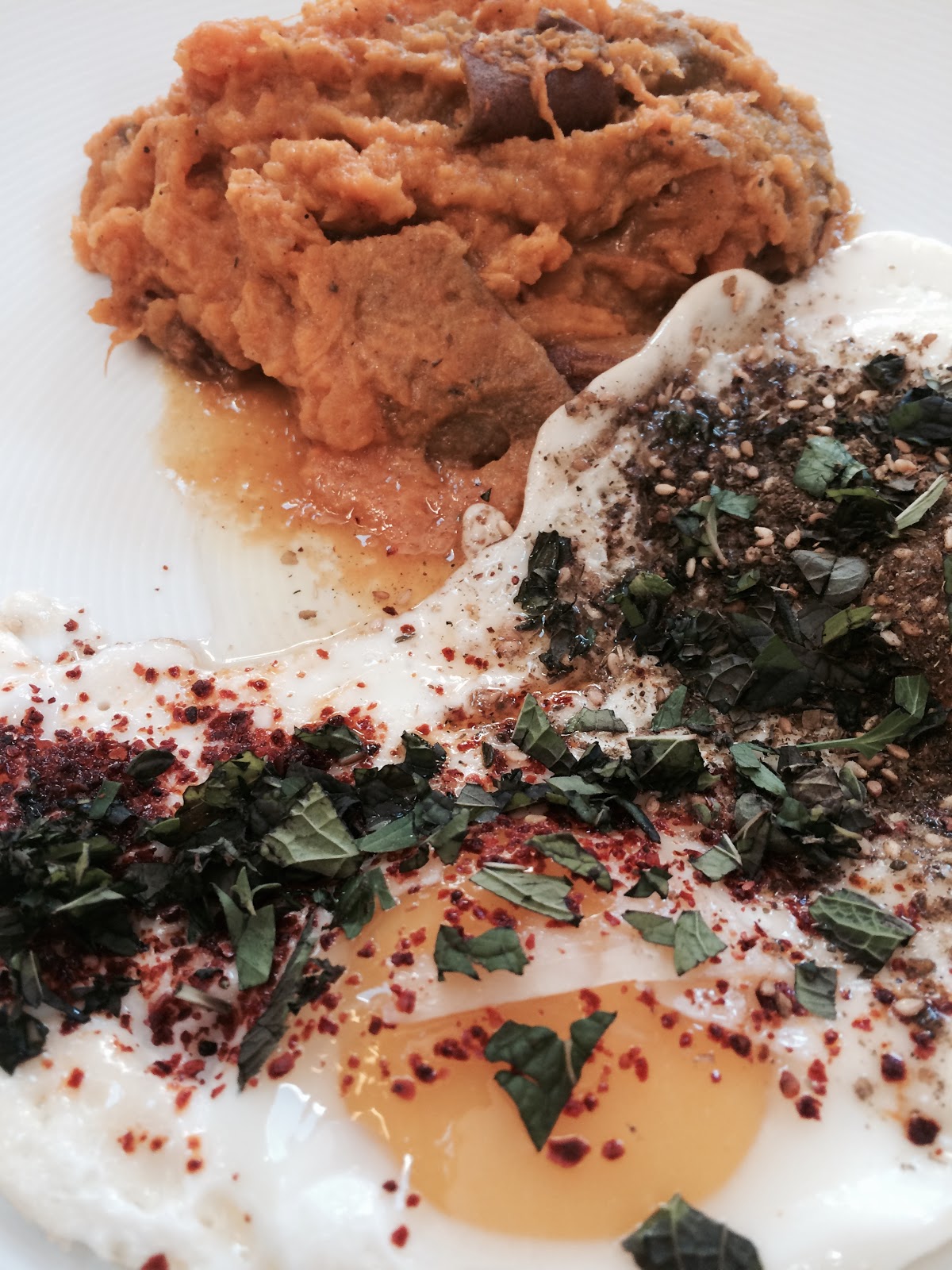
| HOMEMADE FOOD THAT CAN'T HURT YOU: Two cage-free organic eggs from Costco Wholesale with shaved Parmigiano Reggiano Cheese and Middle Eastern flavors, Aleppo pepper, za'atar thyme mixture and chopped fresh mint from our garden, served with skin-on sweet potatoes mashed with extra-virgin olive oil. |
 |
| Late-summer tomatoes from our garden with shaved Parmigiano Reggiano Cheese and Earthbound Farm Organic Spring Mix (Costco Wholesale), dressed with organic Spanish extra-virgin olive oil and balsamic vinegar. |
 |
| Pan-fried whole red snapper with garlic, onion, carrot, and sweet and hot peppers, all doused with hot vinegar and pimiento. The whole wild-caught fish were $6.99 a pound at H Mart in Englewood. |
 |
| Fresh wild sockeye salmon fillet with pesto and organic diced tomatoes, all from Costco Wholesale, served with whole-wheat pappardelle. |
 |
| DINNER IS SERVED: Leftover wild salmon is delicious right out of the refrigerator over organic spring mix with garden tomato slices, dressed in extra-virgin olive oil and balsamic vinegar. |
 |
| I grilled the salmon for 6 minutes on a preheated non-stick pan I sprayed with oil (medium high heat), starting them skin-side down, flipping them after 3 minutes and in the final minute, back onto the skin. Before I cook the fish, I add fresh lime juice and a little sea salt. |
 |
| I cooked down a 15-ounce can of organic diced tomatoes with a half-cup of red wine, garlic powder, black pepper and other seasonings before I started to boil the pappardelle, which take about 11 minutes. When the timer hit 6 minutes, I put the fish on the preheated grill pan. The pesto requires no heating before you add it to the drained noodles. |