Showing posts with label Coleman Natural. Show all posts

Friday, February 5, 2016

At H Mart, first sighting of Perdue chicken raised without antibiotics

Perdue, which has been selling low-quality chicken for decades, says its Harvestland birds are raised on all-vegetarian diet free of harmful antibiotics and animal by-products, such as kitchen scraps and bits of dead animals.

At H Mart in Englewood, boneless Harvestland thighs or what Perdue calls "filets" were a pricey $4.99 a pound. Chicken drumsticks, at $2.99 a pound, are more competitive. 

Editor's note: On a trip to pick up organic eggs and prepared Korean food, I noticed a new brand of Perdue Chicken. 

By VICTOR E. SASSON
EDITOR

I was heading for the fish counter at H Mart in Englewood the other day when packages of chicken caught my eye.

The Korean supermarket is the first store I've seen that stocks Perdue chicken raised without any kind of antibiotics.

This after decades of selling birds pumped up on harmful antibiotics, and spending millions on deceptive advertising to make the public think Perdue chickens were naturally raised.

Even the Perdue tractor-trailers I've seen on the turnpike had a farmhouse painted on their sides to counter the reality of chickens raised in crowded conditions and growing so large they sometimes fell over and could not get up again. 

We've been buying other antibiotic-free brands, including Coleman and Readington Farms, at Costco Wholesale and ShopRite, and probably won't change to Harvestland.

Perdue's Harvestland brand doesn't replace the cheaper chicken Perdue raises conventionally with harmful antibiotics.


Whole Harvestland Chickens were $2.88 a pound.

Jumbo Brown Organic Eggs were on sale for $3.99 at the H Mart in Englewood, the closest I could get to the $3.50 a dozen Costco Wholesale charges for Large Brown Organic Eggs.

Cage-free, non-organic eggs also were $3.99 at H Mart.

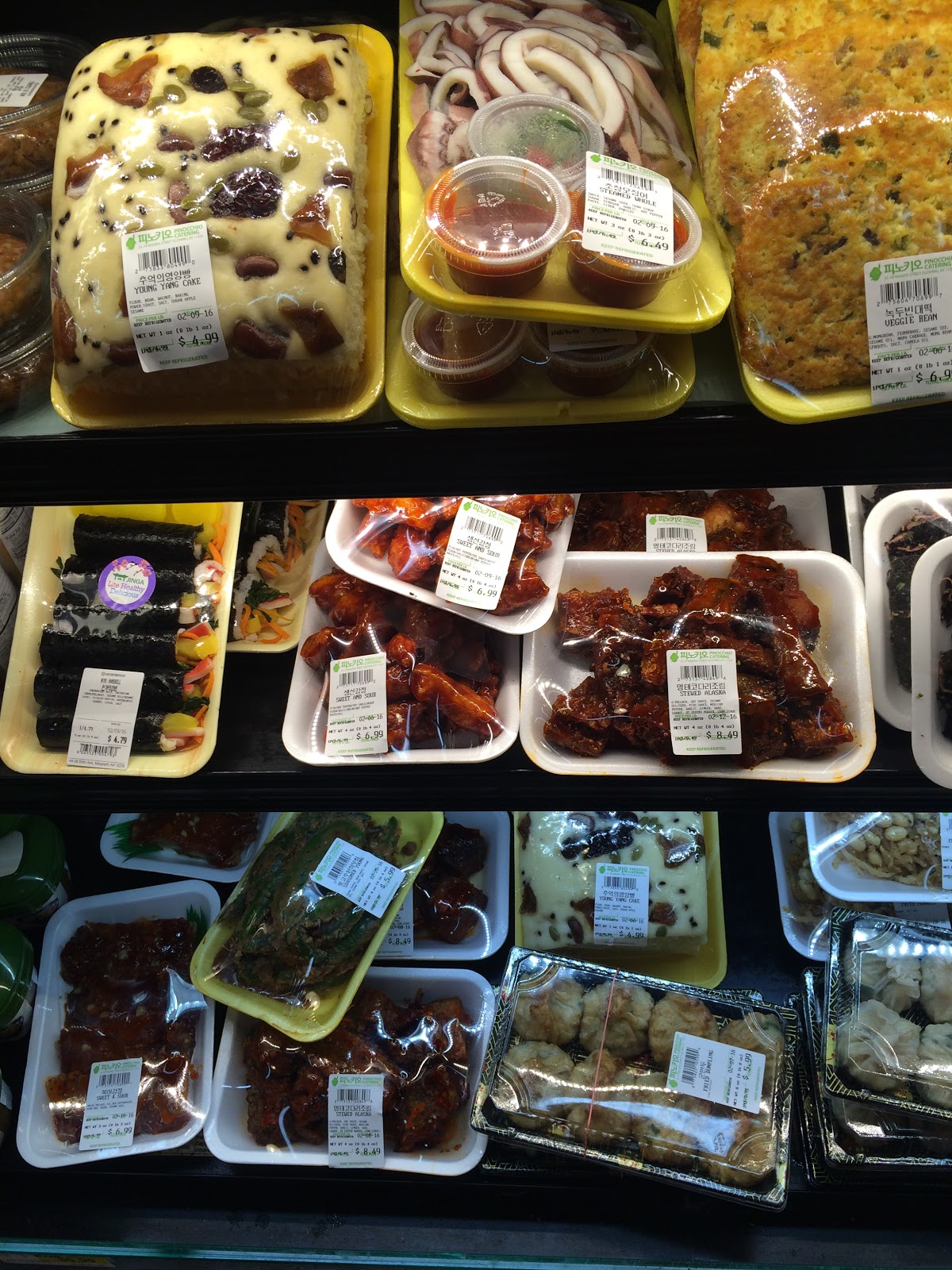
The H Mart at 25 Lafayette Ave. in Englewood has a large selection of prepared food, including panchan, the traditional side dishes served with every Korean meal, above and below.


The H Mart store makes its own items, but also sells food from Jinga and other outside caterers. Prices went up sharply last year.

The package of Jinga Whole Roll or Kimbap I bought for $6.79 was labeled 16 ounces, but weighed more than that on my kitchen scale, lessening the sting.

Jinga's Whole Roll is meatless. Ingredients include seaweed, rice, egg, pollock and crunchy julienned vegetables, and the package includes hot jalapeno slices and Korean pickles. This serving made a light dinner followed by a big salad.

Tuesday, January 26, 2016

Consumer Reports: How dangerous bacteria travel from farm to table

This easy to understand graphic appears in the January 2016 issue of Consumer Reports, a magazine that has taken the lead on trying "to stop the antibiotic overuse in meat and poultry production that gives rise to dangerous bacteria."


By VICTOR E. SASSON
EDITOR

You could say the story of how dangerous bacteria gets from the factory farm to your table is full of shit -- or manure, if you prefer a more polite word.

The story begins on farms where healthy animals "are routinely given antibiotics in their food and/or water," and "bacteria that's present in the animals' intestine react with the antibiotics," Consumer Reports says.

"Some of the bacteria are killed, but a few survive. Those resistant bacteria flourish."

In the final part of a three-part series, the magazine traces bacteria that are resistant to antibiotics as animals excrete it in manure, and how the bacteria can be spread to the community.


Many carriers

In the January 2016 issue, the magazine's editors note resistant bacteria or superbugs spread:

"Via soil, when animal waste is used to fertilize crops; via water, when waste seeps into groundwater; and via air, when bacteria are carried by the wind."

Also, "via farmworkers, who pick up the bacteria on their skin and transfer it when they come into contact with other people; and via flies, which carry bacteria they have picked up on the farm."


During slaughter

Even scarier, "resistant bacteria can also contaminate raw meat during slaughter or processing" in a number of ways.

"Plant workers can pick up bacteria on their skin and transfer it to the meat or to other people," and "raw meat sold in supermarkets may contain bacteria that may infect people who handle or eat it."

The bottom line is that people become ill with antibiotic-resistant infections, and some die.


See: The Rise of Superbugs


Factory farms

Nowhere are antibiotics "more inappropriately employed than in the meat and poultry industries," according to Consumer Reports.

"Abut 80 percent  of the antibiotics sold in the U.S. are give to animals raised for food -- including hogs, cattle, chickens and turkeys.

"The most recent data from the Food and Drug Administration show that more 32 million pounds of antibiotics were sold for use food animals in the U.S. in 2013 -- up 17 percent from just four years earlier."

About 20 percent of people sickened by an antibiotic-resistant bug don't pick it up in the hospital or from another person -- they get it from food."


Best practices

The article contains two lists showing which chain restaurants, and meat and poultry producers use human and animal antibiotics, and which don't.

I was surprised to learn that Coleman Natural and Niman Ranch, two brands known for organic or naturally raised meat and poultry, are owned by Perdue, which uses antibiotics widely.

The only chains that ban antibiotics for growth promotion and disease prevention, as well as other drugs, are Chipotle Mexican Grill and Panera Bread (beef, chicken, pork and roasted turkey).

What you can do

I've stopped eating meat and poultry altogether, but other family members look for organic or antibiotic-free beef, chicken and turkey.

When I buy seafood, I look for wild-caught fish and shrimp or farmed fillets that are raised without antibiotics.