Saturday, December 10, 2011

Fire sale on all-natural turkey parts

Whole Foods Market
Image via Wikipedia


More than two weeks after Thanksgiving, Whole Foods Market in Paramus is still selling turkey -- and it's a bargain.


Last week, I picked up trays of turkey drumsticks and thighs for only 99 cents a pound. I called the butcher counter this morning, and was assured more parts were available at this price.


As with all Whole Foods meat and poultry, the turkeys were raised on a vegetarian diet free of antibiotics and growth hormones.


At 99 cents a pound, these turkey parts are cheaper than antibiotic-free chicken parts from Readington Farms or Coleman Organic.


Two large turkey thighs at Whole Foods were $2.07, and trays of two drumsticks were $1.64 and $1.91.


For dinner, I picked up 2 pounds of Blue Bay farmed mussels from Canada for $5.99.


I gladly pay more than at other stores, because these mussels are ready to remove from the net bag and put in a pot.


All I have to do is add chopped tomato, a few ounces of cheap sake and seasoning, and steam them open. They are always grit free -- unlike mussels I've purchased elsewhere.


This is a two-course meal: tender meat plucked from the open shells and a delicious broth.


Whole Foods Market, 300 Bergen Town Center, Paramus;
201-226-1244. Open seven days 8 a.m. to 10 p.m.
Enhanced by Zemanta

Tuesday, December 6, 2011

Holiday hits and misses at Costco

Niman Ranch
Image via Wikipedia
Costco now sells Niman Ranch hams.


The vast majority of meat being sold at Costco Wholesale is raised conventionally -- huge hunks of pork, thick steaks and whole chickens with labels that tell you nothing about how the animals lived.


Today, I dropped into the warehouse store in Hackensack to take a closer look at Costco's Kirkland Signature holiday ham and was pleasantly surprised to see a second ham -- this one from the Niman Ranch, a highly respected source of naturally raised meat.


Both half hams are bone-in, spiral sliced and fully cooked, but the Niman Ranch markets meat from hogs that are raised on vegetarian feed, and never receive antibiotics and growth hormones.


The Niman Ranch ham was $3.99 a pound, compared to $6.99 and $7.99 a pound -- depending on size -- for Niman Ranch hams at Whole Foods Market in Paramus. 


I believe the ones at Whole Foods are uncured, while the Costco version is cured and contains sodium nitrite as a preservative. 


The Niman Ranch Web site (Niman Ranch FAQs) had this to say about preservatives:
"Nitrates occur naturally in many foods; in fact, you might be surprised to discover that nitrates occur naturally in all plants. The amount of nitrates and nitrites you ingest when eating cured products is negligible and does not pose any health risk. Some consumers prefer cured meats, while others prefer to avoid added sodium nitrate and sodium nitrite, so Niman Ranch offers both alternatives in our product line. The idea to cure meat began with a need to keep meat from spoiling." 
The only other naturally raised meat at Costco is grass-fed lamb from Australia, available in legs, racks and osso bucco, and organic ground beef from Oregon (3 pounds for $13.99).


Holiday seafood


The fresh fish case in Hackensack is filled with several new items for the holiday, including salted, wild-caught Pacific cod ($8.99 a pound) and previously frozen octopus from the Philippines ($3.99 a pound).


Large, wild-caught lobster tails from Colombia are $19.99 a pound, but they're treated with sodium bisulfite as a preservative. We once tried the fully cooked Dungeness Crab ($5.99 a pound), but didn't care for it.


Today, I picked up fresh, wild caught Pacific cod fillets for $7.99 a pound. Costco usually also carries wild-caught haddock and flounder fillets; everything else is farmed.


Kirkland Signature's preservative-free, smoked wild sockeye salmon from Alaska made a reappearance in Hackensack after an absence of about a week, still at the terrific price of $15.39 a pound.


All the other smoked salmon and steel-head trout in the case is artificially colored.


Salad days


When Earthbound Farms' Organic Spring Mix has a use-by date of less than a week, I usually pick up Grand Parisian Complete Salad.  


You get 16 ounces of both, but the latter isn't organic, and the weight listed on the bag includes toppings (feta cheese, dried cranberries and frosted almonds) and a white balsamic dressing.


There appears to be about 10 ounces or less of pre-washed romaine lettuce and other ingredients in the Grand Parisian bag for a total price of $3.79, compared with Earthbound Farms' price of $4.79 to $4.99. 


Sparkling cider


Costco also has Martinelli's Sparkling Apple Cider at four bottles for $7.99 or about $2 each, compared with $2.99 a bottle elsewhere.


Two 32-ounce containers of Kirkland Signature non-fat Greek-style yogurt are $7.99 or about $3.50 each, compared to $4.99 for a single, 35.3-ounce container of Fage Greek Yogurt.


This week, I saw a new item: Della-brand Organic Brown Rice. A 12-pound bag of the long grain rice was $12.99. The cooking instructions say nothing about soaking the rice before you prepare it on the stove top or in a rice cooker -- a real time saver. 


I've passed up Phillips Maryland-Style Crab Cakes, which have risen in price to $14.89 for six. They taste terrific, because the first ingredient listed is crab. On Dec. 3, an instant coupon knocked off $3.90. I should have bought two packages instead of one.


Enhanced by Zemanta

Vegan kimchi, breakfast fish, beef update

Gimchi, a very common side dish in Korea
Image via Wikipedia
Vegan Kimchi is now available in Englewood.


With its heavy reliance on beef, you wouldn't think Korean cuisine attracts any vegans, though vegetarians who eat fish and eggs can find plenty to eat.


Now, an Englewood-based company has introduced a vegan cabbage kimchi that is made without the usual salted shrimp and anchovy sauce.


The ingredient list for Arirang-brand Vegan Kimchi is short: Napa cabbage, daikon redish, salt, red pepper, garlic, ginger, water, sugar and scallion. No additives or preservatives are used.


The nutritional label on Arirang's standard cabbage kimchi, called mahk kimchi, says there are 160 milligrams of sodium in 1 ounce of the traditional, fermented product or about 7% of the daily recommended amount.


Without salted shrimp and anchovy sauce, the peppery Vegan Kimchi probably has even less sodium. It is available in 19-ounce jars where it is made:


Gaboh Inc., 191 W. Englewood Ave., Englewood; 201-503-1314.


Fish for breakfast, dinner


I had another terrific egg-and-fish breakfast at The Golden Grill in Teaneck.


Last time, I ordered the restaurant's fish cakes with my eggs, but this time, I asked for whiting, two eggs over easy and hash browns, but no toast. 


There were two hot, crispy fillets of fried whiting on top of my potatoes, and I could break off pieces and soak them in the wonderful yolks. Everything was even better with a liberal amount of Cholula Mexican hot sauce from a bottle on the table.


The breakfast special is $6.95, and tea was an extra $1.25. A great, meatless breakfast.


Last night, I had one of the great, meatless Meals To Go from Jerry's Gourmet in Englewood -- a multi-course, restaurant-quality dinner for sensible appetites.


The centerpiece was a small, wild-caught grouper fillet in roasted-pepper sauce, served with a thick artichoke frittata, five or six shrimp, roasted potatoes and a big, stuffed mushroom -- a total of 12 ounces.


Even though I gave my wife the penne with pancetta in cream sauce that came with my meal in exchange for a tangle of cooked thin, white asparagus from her meal, I was pleasantly full with the addition of a small salad I made.


Our other meals from Jerry's were barbecued chicken wings and roasted tilapia.


For years, the Meals To Go were only $6.99. But now Jerry's has raised them to $7.99, still a good deal and one of the best takeout values in North Jersey. 


The prepared meals are in a refrigerated case in the main part of Jerry's, though they are usually gone by early afternoon. Don't reheat the food in the plastic container; plate it first before popping it into the microwave.


The Golden Grill, 1379 Queen Anne Road, Teaneck; 201-837-1078.


Jerry's Gourmet and More, 410 S. Dean St., Englewood; 201-871-7108.


Australian beef update


After I published my last post, O say can you taste the grass?, I was contacted by Meat and Livestock Australia Ltd. (MLA) with corrected information on how beef is raised Down Under.


MLA said cattle raised for Nature's Reserve beef, a brand sold at ShopRite supermarkets in North Jersey, receive some growth hormones, even though they are free range and grass fed.


Originally, MLA said neither the beef or the lamb I wrote about contained growth hormones. Now, it says only the grass-fed lamb is hormone-free. 


Related posts
Enhanced by Zemanta

Sunday, December 4, 2011

O say can you taste the grass?

In the pastures
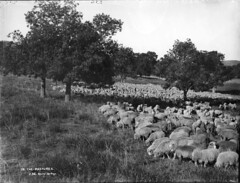
Image by Powerhouse Museum Collection via Flickr
Raising sheep on grass is common in Australia.


Editor's note: Today, I discuss grass-fed beef, lamb, milk, cheese and eggs, all of which are available in North Jersey.


The phrase "all natural" is thrown around with abandon, but there are no government or food industry standards to enforce it.


The best you can do is to look for meat and dairy products from animals that are treated humanely and raised on their natural diets -- free of antibiotics, growth hormones and animal byproducts.


Chief among them are pasture-raised Australian beef and lamb sold at ShopRite supermarkets, Costco Wholesale and other stores.


Unfortunately, labels carry little information on how cattle and sheep are raised in Australia, but ShopRite sales fliers call the beef -- sold under the Nature's Reserve brand -- "All Natural, Free Range, Grass Fed."


I was told by Meat and Livestock Australia Ltd. (MLA) that Nature's Reserve beef comes exclusively from cattle that are fed grass from start to finish. They are never confined to a feed lot, but they do receive some growth hormones.


The racks and boneless legs of lamb sold under the Costco label, Kirkland Signature, or sold without that label, such as the lamb osso bucco I saw last week in the Hackensack warehouse store, are from sheep raised in the same way-- except they do not receive any growth hormones.


Originally, MLA told me no growth hormones were used in beef sold under the Nature's Reserve label, but later corrected that.


Cattle and sheep stomachs are designed to turn grass into protein. When cattle are fed grain -- as the vast majority in the United States are to speed growth -- they can become sick. 


And the wide use of animal antibiotics is making humans resistant to prescribed antibiotics.


Nature's Reserve steaks, roasts and whole beef tenderloin for filet mignon are sold at ShopRite for about $6.99 a pound and even less when they are on sale. 


The meat is lean and contains beneficial Omega 3 fatty acids. It cooks quicker than conventional beef and is best when prepared medium rare.


I once saw grass-fed steaks from New Jersey on sale at Whole Foods Market in Paramus for $9.98 a pound, and the Fairway Market across town sold grass-fed, rib-eye steaks for $14.99 a pound and grass-fed burgers for $5.99 a pound in June 2010.


On Saturday, Costco's prices for Australian grass-fed lamb were $5.99 a pound for the boneless leg, $7.99 a pound for loin chops and $13.99 a pound for racks.  


Before I stopped eating meat nearly two years ago, the small lamb chops in the rack were my favorite. I would trim the rack and cut it apart, broiling the chops only until they were rare. They would literally melt in my mouth.


Of course, you don't taste the grass. But the meat is so pure and flavorful, compared to conventionally raised lamb, it needs little more than a bit of salt.


The current price of $13.99 a pound for a rack of lamb chops at Costco compares to the price I recall from a couple of years ago, $9.99 a pound.


The Australian whole beef tenderloin was ideal for slicing thin, marinating with Korean barbecue sauce and cooking quickly on a stove-top grill before wrapping the beef in red-leaf lettuce with rice, kimchi and garlic at the table.


Grass-fed beef and lamb are among several products from pasture-raised animals available in North Jersey.


Fairway Market sells milk from grass-fed cows. Trader Joe's has sharp cheddar cheese made with milk from pasture-raised cows in New Zealand ($5.49 a pound).


On Friday, for $5, I picked up two dozen Grade A Large Brown Eggs "from grass-fed hens with freedom in the field" at H Mart, the Korean supermarket in Englewood. The yolks are a healthy shade of yellow.


They are distributed by Swiss Villa LLC in Lykens, Pa., with a label that tells you the package is made from recycled PET, fewer than 350 hens forage on a pesticide-free acre of pasture "spring to fall," and the eggs come from "Swiss-peasant-descendant, small-scale farmers."


"You would enjoy seeing the hens scatter out over the pasture meadow each morning as dew droplets mirror the rising sun," the label says. 


I'm sure I would, as long as I was served a breakfast of their eggs right away.


Here are Web sites to help you find grass-fed meat.


Australian Lamb


The site lists Costco Wholesale and Stop and Shop supermarkets as sources of Australian lamb. Some brands to look for are Country Meadow Austral American Lamb and Opal Valley.


Australian Beef


ShopRite and Pathmark supermarkets in North Jersey are listed as sources.


Meat and Livestock Australia Ltd.


Meat and Livestock Australia is a marketing, research and development  agency that represents ranchers, processors, exporters and others involved in meat production in Australia.


To take a virtual farm visit in Australia, click on this link: 


On a Farm Down Under


Enhanced by Zemanta

Thursday, December 1, 2011

Shopping for food here and there

Trader Joe's West Hartford
Image via Wikipedia
Inside a Trader Joe's. The Paramus store is selling holiday hams that are preservative-free, but contain antibiotics.


Editor's note: Today, I discuss this week's food shopping, which covered a lot of ground, and the last duck egg of six I bought for Thanksgiving.


International Food Wine and Liquor Warehouse in Lodi. H Mart in Englewood. Trader Joe's in Parmaus. Shop-Rite in Englewood. Costco Wholesale in Hackensack.


Round and round I go as I try to satisfy my family's demand for fresh food with a globe-spanning diversity -- at prices that constitute a good deal.


On Monday, I drove over to National Wholesale Liquidators in Lodi in search of a Sony Radio Walkman my wife wanted, but spent most of my time looking over the food there and in the adjacent International Food Warehouse.


Although signs tell you what a great deal you're getting, I was shocked at how few items were being sold at lower prices than other stores. Beer and wine prices seemed high.


I bought two quarts of  Lowell 100% pomegranate juice from the country of Georgia at $2.99 each, and two half-gallons of Middle Eastern-style yogurt drink at $4.59 each.


The Karoun-brand, all-natural Yogurt Drink comes all the way from California, so I'm wondering why the store doesn't carry yogurt drinks made and sold in Paterson, where I usually buy them.


I saw imported pasta in fancy, cellophane-wrapped boxes for $3.99 or $4.99, and that was for only 8 ounces, meaning this Italian product goes for $8 to $10 a pound. Ridiculous.


On Tuesday, after a bowl of Yankee bean soup and a cup of coffee at the Suburban Diner on Route 17 in Paramus, I drove less than a mile to Trader Joe's.


I picked up 2 pounds of organic D'Anjou pears in a bag for $2.49; 12 ounces of Trader Joe's Sliced Jalapeno Yogurt Cheese for $4.79; and a small block of Sharp Cheddar Cheese made with milk from grass-fed cows in New Zealand for $3.62 ($5.49 a pound).


Trader Joe's sells a lot of preservative- and antibiotic-free bacon, cold cuts and hot dogs, so I was disappointed to see its holiday hams are nitrite- and nitrate-free, but appear to be from hogs that were raised on antibiotics and growth hormones.


That afternoon, my wife stopped at H Mart in Englewood for fresh, whole striped bass ($3.99 a pound); a Korean-style seaweed, rice and vegetable rice roll from Jinga ($4.99), and scallions (three for $1).


My wife prepared the fish on the stove top in a covered skillet with sliced onion and sweet pepper, extra-virgin olive oil and seasonings, and I removed mine after about 20 minutes.


I loved all the meaty flesh and a minimum of bones, enjoying the fish with stir-fried noodles and vegetables I picked up at H Mart last week, and a big salad. Don't forget to eat the tender  "cheeks" from the fish head.


At ShopRite in Englewood on Wednesday, I picked up two packages of antibiotic-free Readington Farms chicken parts, and one package of Coleman Organic chicken drumsticks -- all on sale.


A 5-pound box of clementines from Spain were $5.48, an in-store special, and they proved far sweeter than the first box of Spanish clementines I got there for $4.99.


The Moroccan clementines I bought at ShopRite for $4.99 were bigger than their Spanish rivals, but several turned black outside and in, and I had to throw those away. I left them on the counter, but maybe I should have refrigerated them.


Later Wednesday, I stopped at Costco in Hackensack for Jona Gold apples (5.5 pounds for $5.99); Newman's Own 100% Grape Juice ($6.99 for two 96-ounce bottles); bananas, 3 pounds for $1.39; and three, 32-ounce bottles of Classico Traditional Tomato-Basil pasta sauce for $6.99.


Four, 7-ounce cans of Genova-brand Solid Light Yellowfin Tuna in olive oil were $7.49 or about $1.25 each; and six quarts of Kirkland Signature Organic Chicken Stock were $10.99 or about $1.83 each.


Why a duck egg?


That night, I finished the last of six duck eggs I bought at the Goffle Road Poultry Farm in Wyckoff.


Duck eggs are about twice the size of a typical chicken egg, and they have much larger yolks, perfect for frying sunny side up in olive oil and eating over brown rice, as I did, mixing the wonderful yolk and the nutty kernels for a terrific taste combination.


But the shell of a duck egg is much thicker, and takes a bit of effort to crack. I ate three duck eggs in Korean-style, soft-tofu soup I made at home.


The best result I got -- a molten yolk -- was when I boiled the soup on the stove, broke an egg into it and let it cook for only 1 minute. Then, I could break the yolk over the brown rice I ate as a side dish.


At $1.25 each, these duck eggs are a once- or twice-a-year splurge.


International Food Wine and Liquor Warehouse, 
370 Essex St., Lodi; 201-368-9511.


Trader Joe's, 404 Route 17 north, Paramus;
201-265-9624.


H Mart, 25 Lafayette Ave., Englewood;
201-871-8822.


ShopRite in Englewood; 201-816-8330.


Costco Wholesale, 80 S. River St., Hackensack.


Goffle Road Poultry Farm, 549 Goffle Road, Wyckoff;
201-444-3238.


Monday, November 28, 2011

Hospital salad bar offers pie

Shin Ramyun
Image via Wikipedia
I took a good look at the ingredients listed on the package of my son's favorite ramyun.


Editor's note: This morning, I made a second visit to the cafeteria at Englewood Hospital and Medical Center, and stocked up on one of my son's favorite breakfasts.


You never know what you'll find on the cafeteria salad bar at Englewood Hospital and Medical Center -- besides salad, that is.


This morning around 9, the salad bar held more than a dozen slices of pie, and no salad. Although I don't eat pie, they looked as if they were filled with cream cheese.


The first-floor cafeteria -- called the Garden Cafe -- is used by doctors, nurses and other hospital employees, in addition to visitors and other members of the public.


On my initial visit to the cafeteria about three weeks ago, I saw a tray of whipped cream with fresh strawberry slices on the fruit salad bar.


Today, walnuts and small cookies were nestled in the whipped cream, in addition to fresh strawberry slices.


A doctor I spoke to after my first visit said the cafeteria is one of the biggest profit centers at the hospital. 


He also said that when the menu was revamped to offer healthier choices, many employees complained, and the person in charge of that effort was let go.


Korean ramen


One of my 14-year-old son's favorite breakfasts is instant Shin Ramyun Noodle Soup (Gourmet Spicy), a Korean version of ramen, but he ate the last one in the cupboard this morning.


I bought this soup for him a few years ago, because it has one of the lowest sodium contents of such instant soups -- 43% of the recommended daily allowance. 


This morning, after cardiac rehab at the hospital in Englewood, I stopped at H Mart to pick up more. 


The Family Pack offered five 4.2-ounce packages for $4.99 or about $1 each, so I bought a box of 20 for $14.99 or about 75 cents each. They weren't on sale.


Using a Japanese-made soup spoon with fork tines, my son usually eats all the noodles and a little of the soup, throwing away much of the broth.  


The ingredients list is long, but "no MSG is added." 


Some of the ingredients are wheat flour, palm oil, powdered beef fat and beef stock; carmel, corn syrup, dehydrated vegetables, garlic, ginger, powdered sand-lance concentrate (a fish), sugar and tocopherols (antioxidant).


The ramyun is made in the U.S.A. by Nongshim America Inc., and has a "best before" date of November 2012.


I also picked up two H Mart prepared items, stir-fried vermicelli noodles with vegetables ($3.50) and radish kimchi ($2.75), each in a 16-ounce package.


I get the impression H Mart prepared food is cheaper than items from Jinga in Maspeth, N.Y., that are sold by the supermarket chain.


H Mart, 25 Lafayette Ave., Englewood; 
201-871-8822. Open seven days.


Related post
Enhanced by Zemanta